
 TV
 VIDEO GAMES
 PODCASTS
 VIDCASTS
 STAND-UP




 MOVIE · 2023
Asteroid City IS WOKE
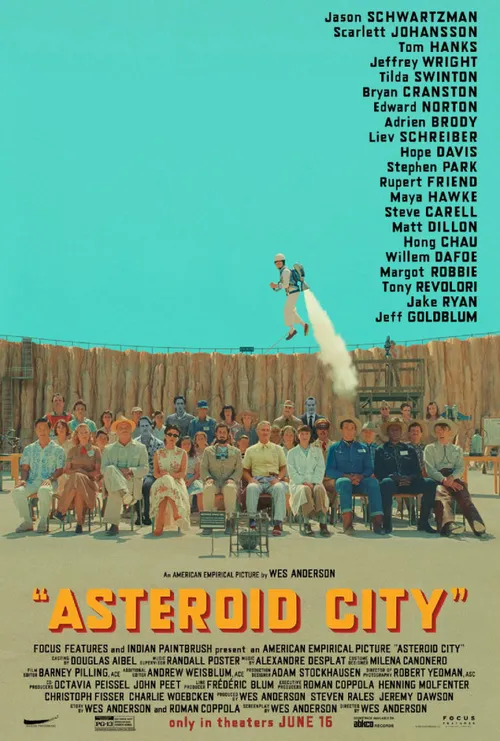
World-changing events spectacularly disrupt the itinerary of a Junior Stargazer/Space Cadet convention in an American desert town circa 1955.
Asteroid City takes place in a fictional American desert town circa 1955. The itinerary of a Junior Stargazer/Space Cadet convention (organized to bring together students and parents from across the country for fellowship and scholarly competition) is spectacularly disrupted by world-changing events.
Oops! Is this show WOKE?
Only an account holder or member can file. Cite a scene, a line, or a pattern. Other account holders +1 or −1 that argument, once each. The show is not IS WOKE until enough of them have given a +1. Enough −1s remove the write-up, and it is no longer shown.
Sign in to file a woke label. One of each criterion per member.
Comments and reviews
Report a mistake
Same rule as woke labels: one report, a written reason, and the community +1 or −1 it — once per member. A net +5 applies the change. Editors can hold it for review, or apply it immediately.
No mistake reports yet.
Sign in to report a mistake. One report per field, per member.
Member review
June Pell
Sep 24, 2026
6/10Asteroid City sat with me longer than I expected, mostly because of how deliberately it keeps you at arm’s length while still asking you to feel something. I went in knowing Wes Anderson’s habits, the centered frames and the pastel desert and the deadpan line deliveries, so none of that surprised me. What did surprise me was how much the grief material actually registers once you stop waiting for a conventional payoff. Augie Steenbeck driving his kids out to that Junior Stargazer convention with his wife’s ashes still in the car is a clean, quiet setup. He can’t quite say the words yet. That part felt honest in a way the rest of the machinery sometimes undercuts. The movie is a play inside a television documentary, and it never lets you forget the layers. Characters step out, directors appear, the whole 1955 Southwest town is presented as a constructed set with motel signs and observatory domes that look like they were painted for the camera. I liked that honesty more than I disliked it. It matches the story’s interest in invention and performance. People invent stories to survive loss; people invent roles to keep moving. When the alien craft shows up and the quarantine locks everyone in, the artifice becomes the point rather than a gimmick. You’re watching people try to make meaning under bright lights that refuse to dim. I found myself thinking about the kids more than the adults at times. The brainy teenagers and the military observers and the scientists near the test sites create this odd little pressure cooker, but the children carry a different kind of weight. They notice things the grown-ups are too busy staging to admit. Augie’s struggle to tell them the truth about their mother is the emotional spine, and Midge Campbell’s presence nearby gives it another texture—two people who know how to perform feelings until the real ones start leaking through. That collision of theatrical distance and actual sorrow is where the film works best for me. There are stretches where the design takes over. The meticulous 1955 look is gorgeous in a flat, postcard way, and the alien landing itself is handled with such straight-faced weirdness that it almost becomes funny. I laughed once or twice at the sheer commitment to the bit. Then the quarantine settles in and the movie starts circling the same questions about control and coincidence and whether any of us are writing our own scenes. I followed those circles willingly for a while. Then I started wanting a clearer emotional through-line instead of another elegant cutaway to the framing device. That’s probably why I landed at three stars. The craft is undeniable. Every frame is considered. The cast leans into the stylized rhythm without winking too hard. Yet the whole thing stays slightly cool to the touch. Grief is named, examined, staged, but it doesn’t always land in the body the way a less mediated story might. I kept waiting for the artifice to crack open into something messier, and when it does, it’s brief. Maybe that’s the point—Anderson showing how we use stories and sets and roles to keep the mess at bay. Fair enough. I just wanted a little more blood under the pastel. A short side path: I once drove through a stretch of desert that looked a lot like this town, minus the observatory and the atomic-test vibe. The light does something to you out there. Everything feels both temporary and permanent at the same time. Asteroid City captures that light perfectly, and then uses it to talk about how temporary our certainties are. The alien arrives, the world pauses, and suddenly every neat plan looks provisional. That idea stayed with me after the credits. The execution didn’t always match the idea’s weight, but the idea itself is worth sitting with. I don’t need every movie to hold my hand. I can appreciate a film that trusts the audience to notice the seams. Still, trust only goes so far when the emotional stakes keep getting refracted through another layer of play-within-a-play. By the end I admired the construction more than I felt changed by it. That’s a respectable outcome, just not a fully satisfying one for me. The Junior Stargazer kids, the war photographer trying to parent through fog, the actress next door—those pieces are strong enough that I kept watching carefully. I just never quite stopped noticing the scaffolding. If you like Anderson’s earlier work and can live with something more openly meta, you’ll probably get more out of it than I did. If you come looking for a straightforward story about loss and wonder, you may feel the same mild distance I did. Three stars feels right: handsome, thoughtful, a little too pleased with its own architecture, and still capable of a few genuine moments when the performance drops and the grief shows through. I’ll remember the desert light and the ashes in the car longer than I’ll remember the clever framing. That balance is enough for a recommendation with caveats, which is exactly where I am.