
 TV
 VIDEO GAMES
 PODCASTS
 VIDCASTS
 STAND-UP
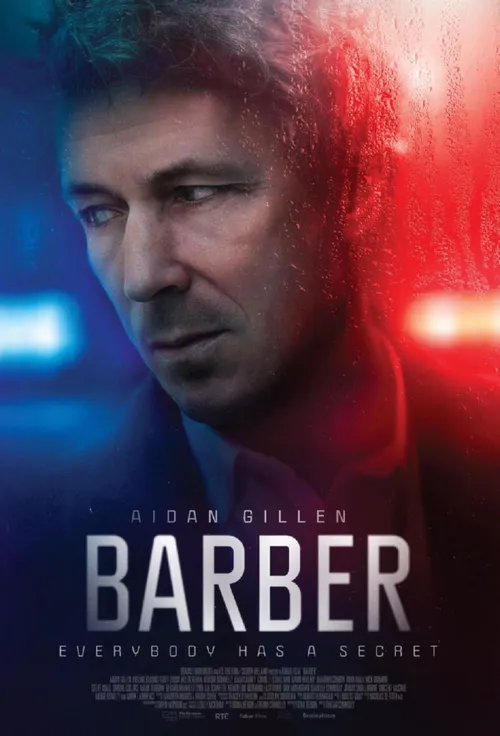




 MOVIE · 2023
Barber IS WOKE
A private investigator (Aidan Gillen) exposes dark secrets and corruption after a wealthy widow's granddaughter goes missing.
In "Barber," an enigmatic barber named Charlie, set against a gritty urban backdrop, grapples with a mysterious past as he tends to a diverse array of clients. Through intimate conversations in his modest barbershop, Charlie uncovers their hidden fears, regrets, and desires, forging profound connections with each individual.
As his clients share their stories, the film explores themes of identity and redemption, blurring the lines between barber and confidant. Charlie's own journey, shrouded in ambiguity, intersects with those of his clients, leading to a poignant, open-ended conclusion that challenges perceptions of self and the quest for redemption. "Barber" is a visual and emotional exploration of the human experience, revealing the transformative power of connection and introspection.
Oops! Is this show WOKE?
Only an account holder or member can file. Cite a scene, a line, or a pattern. Other account holders +1 or −1 that argument, once each. The show is not IS WOKE until enough of them have given a +1. Enough −1s remove the write-up, and it is no longer shown.
Sign in to file a woke label. One of each criterion per member.
Comments and reviews
Report a mistake
Same rule as woke labels: one report, a written reason, and the community +1 or −1 it — once per member. A net +5 applies the change. Editors can hold it for review, or apply it immediately.
No mistake reports yet.
Sign in to report a mistake. One report per field, per member.
Member review
Dan Reilly
Sep 24, 2026
5/10Barber left me mostly cold, and I keep circling back to how little of it actually sticks. The setup is straightforward enough—a private investigator named Val Barber takes a case from a wealthy widow whose granddaughter has gone missing—but the execution never builds the kind of pressure a story like this needs. Early on the film settles into a rhythm of interviews and quiet digs through records that should feel methodical and tightening. Instead it just feels slow. Scenes linger without earning the extra time. Barber talks to people, they hedge or stonewall, he moves to the next name on the list, and the movie treats each of those exchanges like it is loading a spring that never really snaps. I kept waiting for the inquiry to turn a corner into something sharper, and it never quite did. Part of the problem is how thinly the supporting cast is drawn. The widow’s circle is full of people who clearly know more than they are saying, yet almost none of them register as specific individuals with their own reasons for holding back. They function as obstacles or red herrings rather than people whose secrets might actually hurt. When Barber presses them, the resistance feels generic—money, family loyalty, vague unease—rather than the kind of particular motive that makes you lean forward. I started skimming the dialogue in my head after a while because so much of it was doing the same job: delay, obscure, move on. That gets old fast in a missing-person picture. You need the sense that every conversation could crack something open or close a door forever. Here the doors just stay half-shut and the film keeps walking past them. The look of the thing does not help much either. It has a flat, slightly washed-out quality that never settles into a real mood. Night exteriors and dimly lit rooms should carry some weight in a story about hidden family rot, but the lighting and framing stay workmanlike. Nothing feels lived-in or ominous. I never got the sense that the city or the widow’s world had texture. Places appear, serve their scene, and disappear. Same with the granddaughter herself—she is mostly an absence, which is fine in principle, but the movie never makes that absence ache. We get fragments of her routines and contacts without the emotional pull that would make her recovery feel urgent. By the halfway mark I was more curious about whether the runtime would justify itself than about what had actually happened to her. Barber as a character is competent and a little weary, which is the right starting point for this kind of role, yet the script gives him almost no interior life beyond the job. He works the case, notes the inconsistencies, and keeps going. Fair enough for a procedural, but even procedurals need a pulse. I wanted some glimpse of why this particular disappearance got under his skin, or what it cost him to keep sorting genuine leads from noise. Instead he remains a steady camera that the plot moves past. The performance is solid in a low-key way—no overplaying, no false heat—but solid is not the same as memorable. When the pressure is supposed to tighten, as the disappearance starts looking less like a runaway and more like something concealed, the film tells you that shift is happening more than it makes you feel it. I will give credit where it belongs. There are stretches where the methodical approach almost works. Watching Barber cross-check stories and watch people’s faces for the tells is occasionally absorbing, the way a good notebook investigation can be. A couple of the later confrontations land with a bit more weight once the withheld details start piling up, and the film resists the urge to go fully melodramatic or throw in cheap shocks. That restraint is rare enough that I noticed it. The core idea—family secrets layered under a simple missing-person request—has legs, and the movie never completely abandons the idea that ordinary people can protect ugly truths out of habit or fear. Those moments of quiet recognition are the best parts, brief as they are. Still, restraint without tension just becomes undercooked. The ending arrives without the accumulated force the early scenes promised. Loose threads get tied or left dangling in ways that feel more like the script running out of runway than like deliberate ambiguity. I walked away thinking the bones of a better film were in there: a PI who actually listens, a family that has practiced silence for years, a granddaughter whose absence forces everyone to decide what they are willing to keep buried. But bones are not enough. The movie never finds the muscle or the nerve to make those elements hurt. It stays at a polite distance from its own material, and that distance is what keeps it at a middling 2.5 for me. I did not hate the time spent, but I also cannot point to a single scene I would go back to. It is the kind of picture that evaporates once the credits roll, leaving only the vague sense that something more pointed could have been made from the same ingredients if anyone had pushed harder on the characters or trusted the silence less. Maybe that is the real shortfall. Barber wants to be a tense search, yet it rarely risks making the audience uncomfortable or truly uncertain. It charts the path, notes the motives, and wraps up without ever forcing you to sit with the uglier possibilities for long. Competent craft on a thin story will only carry you so far. I wanted the case to get under my skin the way it supposedly gets under Barber’s. It never did.