
 TV
 VIDEO GAMES
 PODCASTS
 VIDCASTS
 STAND-UP
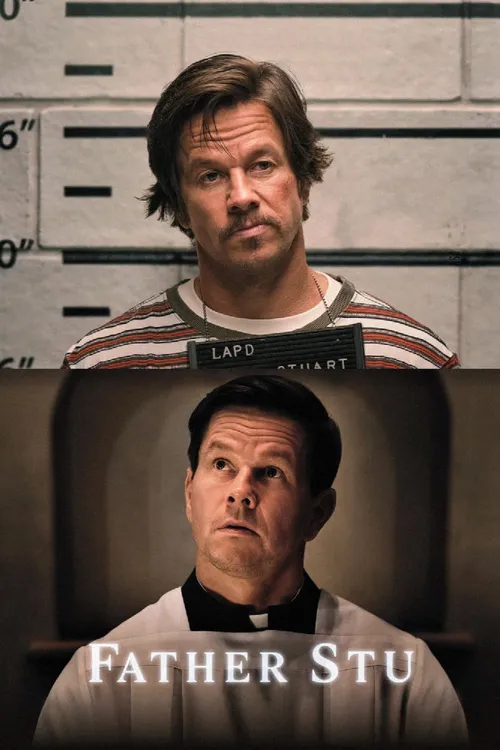



 MOVIE · 2022
Father Stu
Follows the life of Father Stuart Long, a boxer-turned-priest who inspired countless people during his journey from self-destruction to redemption.
Oops! Is this show WOKE?
Only an account holder or member can file. Cite a scene, a line, or a pattern. Other account holders +1 or −1 that argument, once each. The show is not IS WOKE until enough of them have given a +1. Enough −1s remove the write-up, and it is no longer shown.
Sign in to file a woke label. One of each criterion per member.
Comments and reviews
Report a mistake
Same rule as woke labels: one report, a written reason, and the community +1 or −1 it — once per member. A net +5 applies the change. Editors can hold it for review, or apply it immediately.
No mistake reports yet.
Sign in to report a mistake. One report per field, per member.
Member review
Dan Reilly
Oct 2, 2026
7/10Father Stu starts rough in a way that almost lost me. For a good stretch of the early going, Stuart Long comes off as the kind of guy you would cross the street to avoid. He is loud, selfish, quick with a crude joke, and mostly drifting from one half-baked plan to the next. The boxing stuff feels thin, the Los Angeles hustle feels even thinner, and Mel Gibson’s version of the father is pure abrasive energy with almost no soft edges. I kept waiting for someone on screen to become a person I actually wanted to spend two hours with, and it took longer than it should have. The romance with Carmen has that same problem at first. It plays like a guy deciding church might be a useful angle rather than anything genuine, and the movie does not pretend otherwise. That honesty is fine, but it still leaves you stuck watching an unlikable slob work through his options. What kept me from checking out completely is that the film eventually stops apologizing for how messy he is and just lets the mess become the point. The motorcycle crash is the obvious hinge, and it is staged without a lot of Hollywood polish. After that, the shift toward faith does not feel like a sudden personality transplant. Stuart still talks like a guy who used to scrap for a living. He still has the same temper and the same habit of saying the quiet part out loud. The difference is that the movie starts treating those traits as raw material instead of pure liability. I am usually wary of conversion stories that sand everything down into gentle inspiration. This one does not. It lets him stay difficult while he is trying to figure out what the Church actually requires of him. Mark Wahlberg put real money into getting this made, and you can feel that personal stake in the performance even when the script is still finding its feet. He does not turn Stuart into a soft-spoken saint. He keeps the physicality of the boxer and the stubbornness of someone who has already failed at enough things to know failure is coming again. The degenerative disease that starts closing in on him could have been pure pathos. Instead it becomes another practical obstacle he has to argue past, the same way he argues past the seminary people who look at his record and see a liability. Those scenes work better than the early Los Angeles ones because the conflict is clearer. He wants something specific. Other people have good reasons to doubt him. The movie lets both sides stay honest. Teresa Ruiz as Carmen is steadier than the part first appears. She is not there to redeem him with pure goodness; she is there as someone whose faith is already a lived habit, not a plot device. That contrast matters. When Stuart starts taking the Church seriously, it lands because you have already watched him fail at half-measures. Gibson’s Bill Long remains a problem for me even later. The anger and the drinking and the scorn are all dialed up so high that the eventual softening feels more like a required beat than something earned. I get why the character is written that way. A hard father makes the son’s choices look sharper. It still plays like cartoon toughness for longer than necessary. The priesthood material is where the film finally finds a rhythm I could settle into. Stuart serving people who are worse off than he is, speaking without the usual careful language, dealing with superiors who would rather have a cleaner candidate. None of that feels designed to lecture the audience about belief. It just follows one stubborn guy who decided the crash and the girl and the empty years afterward pointed somewhere specific. I am not an easy mark for these stories. Plenty of them treat faith as either a punchline or a glowing special effect. Father Stu treats it as work. That is rarer than it should be, and it is the main reason I stayed with it after the uneven opening. Humor is scattered through the second half in a way that actually helps. Stuart’s bluntness undercuts the risk of the movie turning solemn and pious. You get the sense that the real man probably did talk like that, and the film is smart enough not to clean up the dialogue for comfort. Emotional stretches land harder because of it. When the body starts failing him in earnest, the movie does not milk every frame for tears. It just shows the cost and keeps him moving. That restraint is more effective than big speeches. I still think the first half needed a sharper edit. Too many scenes of Stuart being casually awful start to feel like the movie is testing how much irritation you will tolerate before the turn. Some of the supporting characters stay stuck in one note. And the inspirational framing, even when it is earned, carries the usual biopic risk of making every setback look like destiny in hindsight. Those are real limits. They keep this from being something I would push on people without caveats. At the same time, once it commits to the later stretch, it does the thing a lot of safer faith movies refuse to do. It lets the main character stay rough while the vocation gets serious. Wahlberg’s investment shows up less as vanity and more as stubborn follow-through. The film does not pretend the path is clean or that the people around him were always supportive. For a story that could have gone pure soft-focus uplift, that stubbornness is worth something. I landed at 3.5 because the early drag is real and the supporting work is uneven, but the core of it—the crash, the call, the body giving out while he keeps showing up—holds together better than I expected when I was still stuck watching the unlikable version of Stuart waste time. It is not seamless. It is not subtle. It is, finally, specific enough about one difficult conversion that I stopped waiting for it to become a different, safer movie and just watched the one it actually is.