
 MOVIES
 VIDEO GAMES
 PODCASTS
 VIDCASTS
 STAND-UP
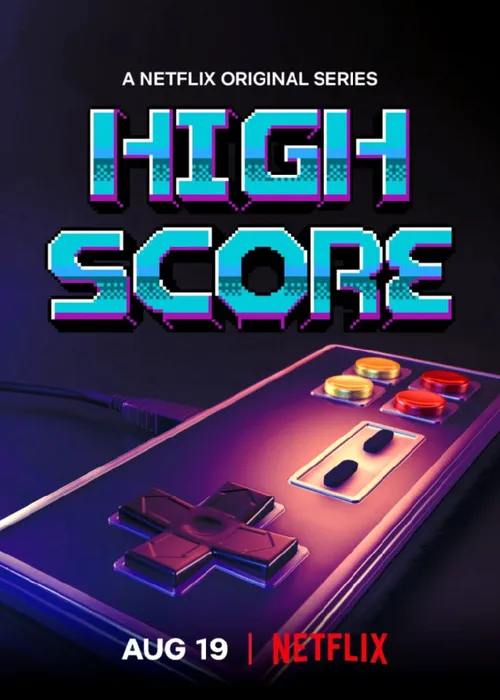



 TV SERIES · 2020
High Score
High Score recounts the rise of arcade and home video games through the people who designed the machines, characters, and companies that defined the medium. It moves from early coin-ops to the console boom with first-hand accounts from the industry’s pioneers.
High Score follows the innovators behind classic video games as they explain how arcades and early consoles turned technical experiments into a mass entertainment business. The series opens on the coin-op era, when figures such as Nolan Bushnell and the teams around Pong and Space Invaders turned bars and malls into gaming floors. Designers describe the constraints of limited hardware, the chase for the next hit cabinet, and the sudden cultural reach of titles like Pac-Man. Interviews with creators including Toru Iwatani and other arcade veterans walk through how characters and scoring loops were built under tight memory and cabinet economics. The narrative then tracks the jump into living rooms as home systems began to challenge the arcade model. Throughout, the focus stays on specific machines, business bets, and the people who shipped them.
Later chapters cover the home-console explosion and the rivalry that pitted Nintendo against Sega and other hardware makers for living-room dominance. Shigeru Miyamoto and other Nintendo voices recount how platformers and character-driven games reshaped what a cartridge could sell, while Sega-side accounts detail Sonic, marketing wars, and the push for cooler, faster branding. The series revisits crash-and-recovery cycles, the role of third-party publishers, and how hit franchises locked in generational fandom. Engineers and executives describe near-failures, licensing fights, and the moment a single title could make or break a holiday season. Relationships between creators, publishers, and platform holders drive the turning points rather than a single fictional plot. The miniseries closes on the lasting imprint those early hits left on pop culture and on the people who still talk about the cabinets and cartridges they shipped.
Oops! Is this show WOKE?
Only an account holder or member can file. Cite a scene, a line, or a pattern. Other account holders +1 or −1 that argument, once each. The show is not IS WOKE until enough of them have given a +1. Enough −1s remove the write-up, and it is no longer shown.
Sign in to file a woke label. One of each criterion per member.
Comments and reviews
Report a mistake
Same rule as woke labels: one report, a written reason, and the community +1 or −1 it — once per member. A net +5 applies the change. Editors can hold it for review, or apply it immediately.
No mistake reports yet.
Sign in to report a mistake. One report per field, per member.
Member review
Stu Kline
Oct 20, 2026
7/10High Score sticks to the people who actually built the early machines and the companies around them. That is the right focus for a series about how arcades and home consoles turned into a business. It opens in the coin-op years and stays there long enough for the constraints to feel real before it shifts to living rooms. I rated it 3.5 because the firsthand pieces work when they stay concrete. Nolan Bushnell and the Pong crowd explain why bars and malls suddenly had rows of cabinets. Toru Iwatani and the other arcade veterans walk through character design and scoring loops under tight memory limits. You hear how little room they had and how that forced the next hit instead of endless polish. Space Invaders and Pac-Man get treated as products that had to earn quarters, not as sacred artifacts. That tone keeps the early episodes honest. The hardware limits come through clearly. Designers talk about what they could and could not do, the chase for another cabinet that paid out, and the moment a simple loop became a cultural object. I like that the series does not pretend every title was destined for greatness. Some were just the next try after the last one underperformed. The cultural reach of those machines is shown through the people who watched lines form, not through a narrator lecturing about importance. Where it settles into average for me is the stretch from coin-ops into the console boom. The jump is necessary, and the pioneers still appear, but the later sections feel thinner. Home systems get covered, yet the scaling of the companies and the failures that sat next to the hits do not get the same time. You get the sense of a mass entertainment business forming, then the series moves on before the business side fully lands. First-hand accounts remain the strength, but they start to function more like checkpoints than deep accounts once the story widens. I came in as someone who missed the peak arcade floors but still spent time on the machines that survived into later years. The pure loop of those early designs is what sticks. No padding, just the next score and the next quarter. High Score captures that without turning every designer into a lone genius. The interviews that dig into the actual desk work and the floor traffic are the parts I trusted. The ones that drift into highlight territory are the parts that kept the score from climbing. Production stays out of the way. Old footage, game clips, and talking heads. No need for staged drama when the people who were there can still describe the rooms and the deadlines. That restraint fits the subject. You do not need it dressed up. The series is better when it lets the makers talk about memory limits and scoring systems than when it tries to summarize an entire era in one clean arc. Breadth is the trade-off. Covering the rise means some stories get shortened. I wanted more on the companies that defined the medium beyond the famous names, and more on the ones that did not make it. The sudden boom had plenty of both. The show acknowledges the hustle and the cultural shift, then keeps moving. That leaves it solid on the innovator side and a little light once the home market takes over. Still, the core idea holds. Technical experiments became entertainment because people figured out how to make limited hardware addictive and then how to sell it at scale. High Score does not oversell the romance of it. Cabinets had to work in loud rooms. Characters had to read in a few pixels. Scoring had to pull another coin. Those practical pressures are clearer here than in most nostalgia packages. Iwatani’s sections and the early coin-op material are the clearest examples. It is not a complete map of every classic title or every corporate turn. It is the industry story told through the people who designed the machines and the characters. That matches what I wanted. Some episodes hold focus better than others. The ones that stay close to the design decisions and the floor reality are worth the time. The ones that list more names without enough of the work underneath are why it sits at 3.5 instead of higher. If the topic already interests you, the interviews deliver enough specific detail to make the watch useful. If you need a tight, even narrative across every chapter, this will feel uneven. I did not need it to be exhaustive. I needed the makers to sound like they were still solving the same problems they faced then. On that point it succeeds more often than it misses. The physical space of the early arcades, the bars and malls turning into gaming floors, comes through in the voices of the people who were standing there. That texture is the part that stayed with me after the credits. The series never pretends the market was pure or that every decision was noble. It just shows how the next cabinet or the next console got built under real limits. That is enough for a middle rating. Worth sitting with if you care about where the medium started. Not something I would force on anyone who does not already have a soft spot for those machines and the people who wired them.