
 TV
 VIDEO GAMES
 PODCASTS
 VIDCASTS
 STAND-UP
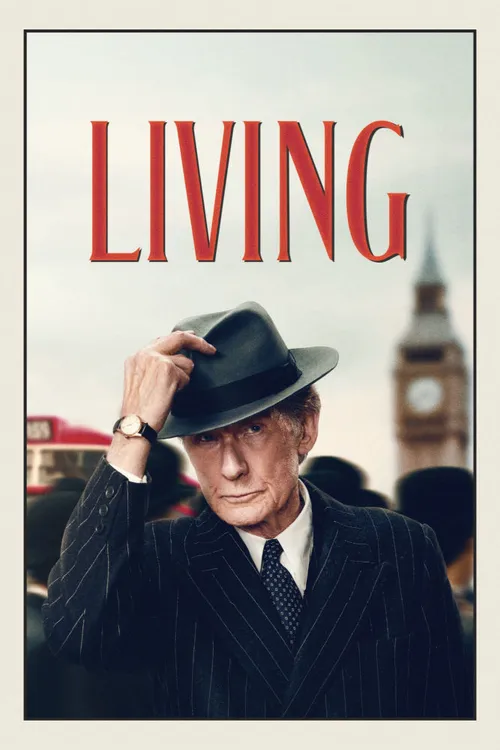



 MOVIE · 2022
Living
In 1950s London, a humorless bureaucrat decides to take time off work to experience life after receiving a grim diagnosis.
Living unravels the enigmatic life of Daniel (Evan Morgan), a tormented photographer caught between past regrets and present struggles.
Set in a coastal town, the film weaves non-linear timelines, delving into Daniel's formative years and his troubled marriage. As memories resurface, the haunting power of regret comes to the forefront, propelling him into an introspective journey of self-discovery.
Oops! Is this show WOKE?
Only an account holder or member can file. Cite a scene, a line, or a pattern. Other account holders +1 or −1 that argument, once each. The show is not IS WOKE until enough of them have given a +1. Enough −1s remove the write-up, and it is no longer shown.
Sign in to file a woke label. One of each criterion per member.
Comments and reviews
Report a mistake
Same rule as woke labels: one report, a written reason, and the community +1 or −1 it — once per member. A net +5 applies the change. Editors can hold it for review, or apply it immediately.
No mistake reports yet.
Sign in to report a mistake. One report per field, per member.
Member review
Wes Calder
Oct 6, 2026
7/10Living sat on my list for a while before I finally put it on. I knew the bare outline going in: 1950s London, a civil servant who gets bad news and decides he has spent too many years pushing paper. That was enough. Bill Nighy plays Mr. Williams the way he often does, which is to say he barely seems to be acting at all. The man is all restraint and quiet dread, the sort of face that has practiced looking blank for decades because blankness was the job requirement. You watch him walk those corridors and you understand why the office feels like a tomb even before anyone mentions illness. I liked the early stretches more than I expected. The gray suits, the endless forms, the polite refusal to notice anything that might require actual thought. It is not flashy. The camera stays still a lot, and the dialogue is clipped in that mid-century British way that can feel either precise or suffocating depending on your mood. For me it worked. You feel the weight of routine without anyone having to announce it. When Williams finally steps outside that world the film does not suddenly become colorful or loud. It just loosens a little, and that small shift is enough. There is a stretch in the middle where he tries to spend money and feel something, anything, and it lands with the right mix of awkwardness and mild horror. Nighy does not overplay the lost-man routine. He looks like someone who has forgotten how to want things and is slightly embarrassed to be reminded. The younger woman from the office who ends up spending time with him is not written as a spark or a savior. She is simply alive in a way he is not, and the contrast does most of the work. I appreciated that the movie did not force a romance or a big speech about seizing the day. It stays smaller than that. The playground project that becomes his late focus is the heart of the thing, and here the film is at its best and its most ordinary. Watching a man who has spent a lifetime saying no slowly learn how to push a simple public good through the system should not be gripping, yet it is. The bureaucracy fights him with the same polite indifference it always used. Paperwork multiplies. Meetings go nowhere. You can feel his remaining time leaking away while everyone else keeps their heads down. When something finally moves, it does not feel triumphant. It feels like a man who noticed he was already dead and decided to leave one small mark before the rest caught up. I will admit the ending stayed with me longer than the middle sections. There is a quiet dignity to how it closes that avoids both sentimentality and cheap cynicism. At the same time, the whole piece is so carefully controlled that it can tip into feeling a bit thin. Certain supporting characters never quite become more than functions. The office comedy, such as it is, stays gentle to the point of fading. And while the period detail is solid, it sometimes feels like the production is more interested in the look of the era than in any sharper observation about it. I never felt preached at, which I count as a relief, but I also never felt the film risked much beyond its central portrait. Nighy’s performance carries more than it should have to. Without him I am not sure the same script would hold attention for the full running time. He makes stillness interesting, which is harder than it sounds. The rest of the cast is fine, occasionally better than fine, yet the movie remains his. That is both its strength and its limitation. You leave thinking about one man’s small awakening more than about the world he briefly disturbed. I rated it 3.5 because it does what it sets out to do without embarrassing itself or the audience. It is thoughtful in a low-key way, well made, and occasionally moving if you are in the right frame of mind. It did not rearrange my week or send me hunting for the original Kurosawa version the next morning, but it also did not waste the time I gave it. Some evenings that is exactly the bargain you want. A quiet film about a quiet man who realizes, late, that quiet is not the same as living. I can respect that without needing to oversell it.