
 TV
 VIDEO GAMES
 PODCASTS
 VIDCASTS
 STAND-UP
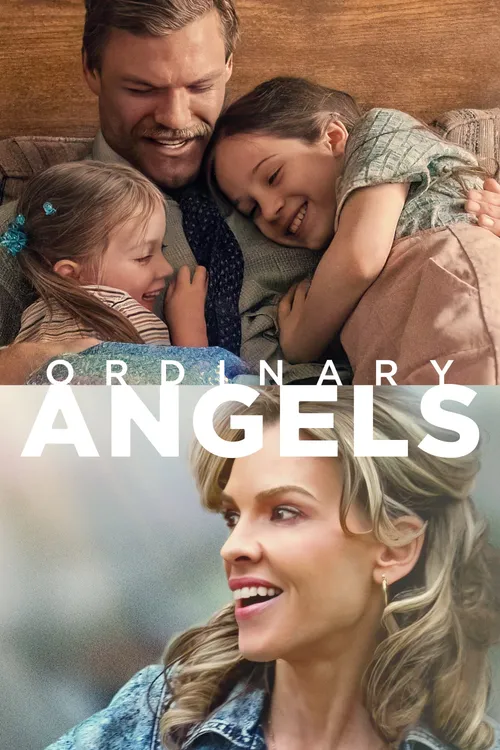



 MOVIE · 2024
Ordinary Angels
Inspired by the incredible true story of a hairdresser who single-handedly rallies an entire community to help a widowed father save the life of his critically ill young daughter.
Based on a remarkable true story, ORDINARY ANGELS centers on Sharon Steves, a fierce but struggling hairdresser in small-town Kentucky who discovers a renewed sense of purpose when she meets Ed Schmitt, a widower working hard to make ends meet for his two daughters.
With his youngest daughter waiting for a liver transplant, Sharon sets her mind to helping the family and will move mountains to do it. What unfolds is the inspiring tale of faith, everyday miracles, and ordinary angels.
Oops! Is this show WOKE?
Only an account holder or member can file. Cite a scene, a line, or a pattern. Other account holders +1 or −1 that argument, once each. The show is not IS WOKE until enough of them have given a +1. Enough −1s remove the write-up, and it is no longer shown.
Sign in to file a woke label. One of each criterion per member.
Comments and reviews
Report a mistake
Same rule as woke labels: one report, a written reason, and the community +1 or −1 it — once per member. A net +5 applies the change. Editors can hold it for review, or apply it immediately.
No mistake reports yet.
Sign in to report a mistake. One report per field, per member.
Member review
Becky Soto
Oct 6, 2026
7/10I went into Ordinary Angels mostly because the premise felt close to ground level. A hairdresser who is not anybody’s idea of a saint decides the little girl across town is not going to lose her shot just because the money and the paperwork are stacked against her. That hooked me right away. Sharon is messy in a way that feels honest. She drinks too much, shows up uninvited, and keeps pushing even when people tell her to mind her own business. I liked that the movie never tries to sand her down into some pure-hearted hero. She is stubborn and sometimes abrasive, and that is exactly why the town starts moving. There is one stretch that has stayed with me. It is late, the weather has turned ugly, and Sharon is still making calls and hauling people into another fundraiser when most of them would rather stay home. You can feel how tired everyone is, including her. She is not giving a speech about hope. She is just refusing to quit because the alternative is letting a kid run out of time. That stubbornness landed harder for me than any big emotional monologue would have. I have known people who operate like that. They are not polished. They just will not leave the problem alone. Ed’s pride is another piece that felt true. He does not want charity, and you understand why. Watching him slowly accept help without turning into a soft character arc was one of the better choices the film made. The relationship between him and Sharon never becomes cute or romanticized in a cheap way. They clash. She oversteps. He pushes back. Somewhere in the middle they figure out how to keep the focus on Michelle. I appreciated that the movie let those awkward edges stay visible instead of smoothing everything into a group hug. The community stuff works when it stays specific. Car washes in the cold, donation jars, people who barely know each other showing up because someone asked them twice. Those scenes feel like the kind of ordinary effort you actually see in small towns when a family is in crisis. I did not need the film to lecture me about kindness. The actions were enough. At the same time, a few of the bigger set pieces lean a little hard on coincidence and timing. You can feel the movie reaching for a swell when a quieter moment would have carried more weight. That is part of why I landed at 3.5 instead of higher. The heart is real, but the craft sometimes telegraphs what it wants you to feel. Sharon’s own struggles with the bottle are handled with a decent amount of restraint. The film does not turn every scene into a recovery lecture, which I was grateful for. You see the cost without constant explanation. There are still nights where she chooses the wrong thing, and the movie lets that sit. It makes her decision to keep showing up for this family more interesting, because it is not coming from a place of perfect self-control. She is fighting herself as much as she is fighting the clock and the bills. I also liked how little the story tried to reinvent the medical crisis itself. The transplant deadline is the pressure, not a metaphor for something else. The weather becomes an obstacle instead of a symbol. People get tired and short with each other. Money is tight. Pride gets in the way. Those are ordinary frictions, and the film is strongest when it stays inside them. When it drifts toward broader statements about community or second chances, it loses some of the texture that made Sharon interesting in the first place. Michelle is written with a light enough touch that she never becomes a pure plot device. You get glimpses of her personality without the movie forcing cuteness. That helped. I have seen too many stories where the sick child exists only to unlock adult growth. Here she feels like a real kid who happens to be in a terrible spot, and the adults around her have to rise to that without turning the whole thing into a lesson. Would I watch it again tomorrow? Probably not. But I am glad I saw it. It reminded me that sometimes the person who changes the outcome is not the most put-together person in the room. Sometimes it is the one who keeps showing up after everyone else has decided the situation is too hard. That beat, the late-night refusal to quit while the storm is coming in, is the part I keep thinking about. The rest of the movie is uneven in places and a little tidy in others, which is why 3.5 feels right. It has a core that works, and a few moments that stick, even if the whole package does not quite reach as high as it aims.