
 MOVIES
 VIDEO GAMES
 PODCASTS
 VIDCASTS
 STAND-UP



 TV SERIES · 2024
Shogun
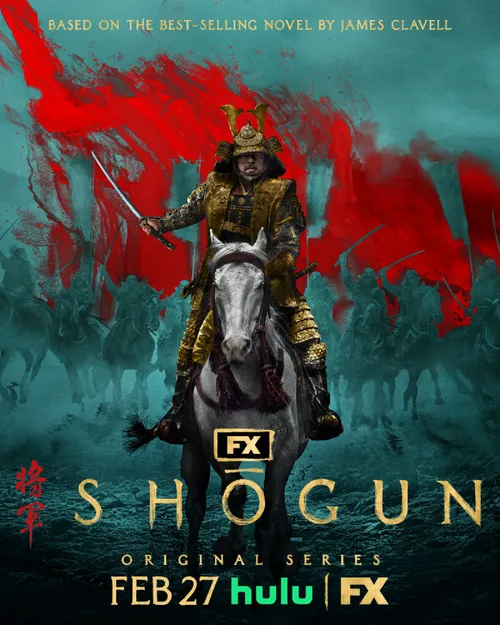
In feudal Japan at the dawn of a century-defining civil war, a shrewd warlord fighting for survival against a united council of rivals forms a strategic alliance with a shipwrecked English sailor who possesses secrets that could alter the balance of power.
The narrative is set in 1600 Japan, on the precipice of a massive civil war following the death of the Taikō. The storyline follows a powerful and calculating lord who finds himself isolated and heavily outnumbered on the Council of Regents, a governing body meant to rule until the young heir comes of age. His precarious situation shifts dramatically when a heavily armed European merchant vessel washes ashore in a poor fishing village. The ship's pilot, an ambitious Protestant navigator, is taken captive but quickly proves invaluable due to his knowledge of global trade routes and his hostility toward Catholic Jesuit merchants and Portuguese priests who have quietly monopolized the region's foreign commerce.
Recognizing the pilot's potential to sow discord among rival factions, the lord takes him into custody and assigns a multilingual noblewoman to act as his official translator. As the translator balances her deep Christian faith against her obligations to her master and her tragic family history, she and the foreign sailor forge a complex bond while training a specialized regiment for the coming conflict. The overarching plot unfolds as a tense, slow-burn psychological chess match driven by political betrayals, intricate court schemes, and severe cultural clashes. Rather than relying on massive battlefield action, the struggle culminates in a series of calculated sacrifices and covert operations in Osaka that ultimately secure supreme power and pave the way for a new era of military rule.
Click any of the following icons below to rent or stream it!
Oops! Is this show WOKE?
Only an account holder or member can file. Cite a scene, a line, or a pattern. Other account holders +1 or −1 that argument, once each. The show is not IS WOKE until enough of them have given a +1. Enough −1s remove the write-up, and it is no longer shown.
Sign in to file a woke label. One of each criterion per member.
Comments and reviews
Report a mistake
Same rule as woke labels: one report, a written reason, and the community +1 or −1 it — once per member. A net +5 applies the change. Editors can hold it for review, or apply it immediately.
No mistake reports yet.
Sign in to report a mistake. One report per field, per member.
Member review
Peg Harlan
Oct 7, 2026
9/10I sat down with Shogun expecting another big historical production that would talk down to me or sand the edges off everything. That is not what I got. This one feels closer to the old way of telling a story, where people make hard choices and live with the results, and nobody stops the scene to explain why you should feel a certain way about it. They used to make them like this. Not often, but when they did, you remembered. The 1980 version had its own power, and I still respect it, but this new one does not try to copy the same shape. It spreads the weight around more, and that works better than I thought it would. The English pilot is still important, yet the Japanese side of the ledger gets real room to breathe. You watch lords and retainers and women of the house move through a world that has its own rules, and the show trusts you to keep up. It neither romanticizes nor condemns that culture. It simply shows it, the good and the bad side by side, and lets the details do the talking. Clothing, houses, weapons, the way people speak to each other—all of it feels considered without turning into a lecture. What held me was how clean the through-line stayed. Every conversation seems to matter. People say less than they mean, and the camera knows when to linger and when to cut. I never felt the pace dragging or racing just to hit a cliffhanger. That kind of control is rare now. After years of loud franchises and shows that pause every ten minutes to make a point about the present day, sitting with something this focused felt like a relief. It is not trying to fix you. It is trying to put you inside a dangerous year and keep you there. The performances stay with me more than any single plot turn. Hiroyuki Sanada carries a lot of quiet calculation; some nights I wanted even more of him on screen, but what is there is sharp. The supporting cast fills the frame without fighting for it. And the women—especially Mariko—are written with real steel. Her fight in episode 9 still sits in my chest. Strength here does not come from shrinking the men around them or from some checklist of modern attitudes. It comes from duty, fear, intelligence, and the narrow choices left when the walls close in. That felt honest to the period and to the characters. I have heard people compare it endlessly to the novel and the older series. Fair enough. The book was a masterpiece of its kind, and the earlier television version knew how to lean on the collision between the outsider and the lord. This version loosens that single focus a little, and for me that was not a loss. It let more of the court intrigue and the smaller human costs come forward. You still get the shock of the foreigner landing in a place that does not need him, and you still get the slow recognition that knowledge and guns and faith can tilt a balance of power. But you also get the sense that these people were already deep in their own war long before the ship arrived. The production never feels cheap. Sets and light and weather all serve the story instead of showing off. I am not a historian, so I will not pretend to grade every detail, yet the care is obvious. You believe the rooms and the roads and the way a man holds a blade. That belief matters when the stakes turn personal. Betrayals land harder when the world around them looks lived-in. Is it perfect? Close enough that the small gripes feel minor. A few stretches in the middle ask for patience, and one or two supporting threads could have used another beat. I also wonder whether some viewers who only want the Blackthorne adventure will feel the shift in emphasis. For me the trade-off was worth it. The larger canvas made the whole thing feel bigger without losing the thread. What I keep coming back to is the absence of the usual noise. No one is scoring points against the audience. Faith, ambition, loyalty, and violence all sit on the table as they are. Christianity appears as one more force among others—Jesuits with their own aims, a Protestant pilot with his—and the show does not turn belief into a cartoon of bigotry or virtue. That restraint is part of why it works. You are left to watch people decide, sometimes badly, sometimes with surprising grace, and then live with what follows. I rated it 4.5 because it earned the high marks on craft and on respect for the material, yet I leave a little room for the parts that could have cut deeper. Still, nights when I want television that treats me like an adult, this is the kind of thing I will return to. It reminds me that a story set four hundred years ago can feel more alive than most of what is shot last month, provided someone cares enough to get the bones right and then get out of the way. Shogun does that. It is serious without being ponderous, and it trusts the viewer to meet it halfway. That is rarer than it should be, and I am glad I watched.