


 TV · 2022
The Offer
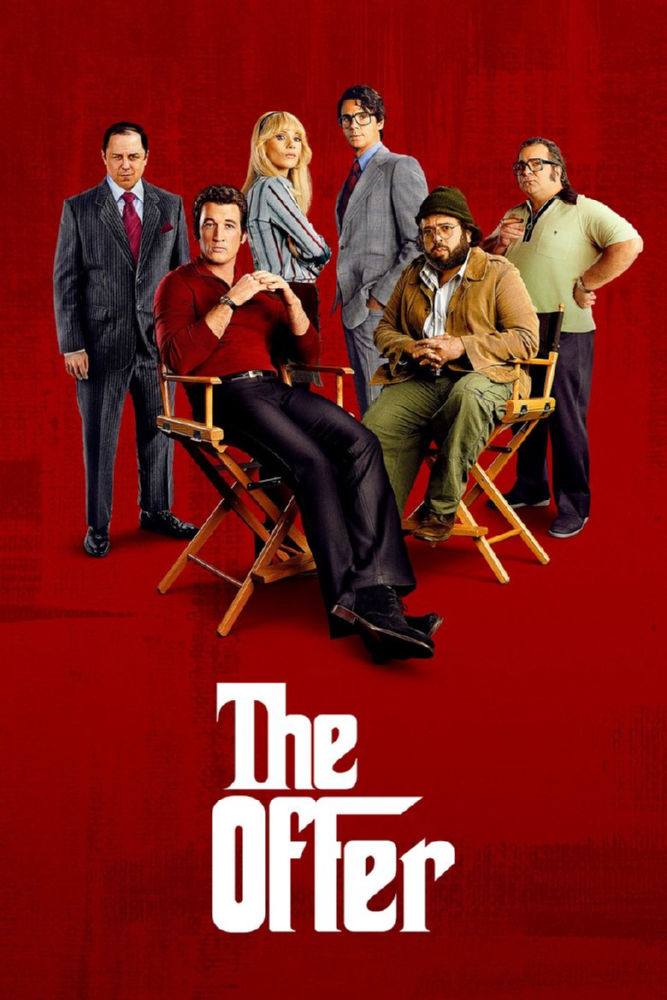
Producer Al Ruddy fights studio executives and real Mafia pressure to get Mario Puzo’s novel The Godfather made into the 1972 film.
The Offer follows Al Ruddy, a brash young producer who secures the rights to adapt Mario Puzo’s bestselling crime novel for Paramount. Ruddy must answer to mercurial studio chief Robert Evans while recruiting director Francis Ford Coppola and keeping Puzo involved in the screenplay. Casting battles erupt over Marlon Brando as Vito Corleone and newcomer Al Pacino as Michael, decisions the front office repeatedly tries to reverse. Ruddy’s sharp assistant Bettye McCartt steadies the production office and shields him from constant interference. Outside the lot, Italian-American activists and actual organized-crime figures begin objecting to the project’s portrayal of their community, turning a Hollywood gamble into a genuine safety threat.
Ruddy opens direct talks with Joe Colombo and the Italian-American Civil Rights League, ultimately striking a pragmatic deal that removes the word “Mafia” from the script and calms the street heat. On set, Coppola clashes with the studio over tone, length, and dailies while budget overruns and location problems mount. Evans and corporate boss Charles Bluhdorn keep second-guessing every choice, forcing Ruddy to bluff, beg, and renegotiate daily. Bettye keeps the machinery running as relationships fray and the shoot threatens to collapse. The finished picture finally reaches theaters, vindicates the risks, and rewrites the careers of everyone who stayed aboard.
Creator: Writer
Click any of the following icons below to rent or stream it!
Oops! Is this show WOKE?
Only an account holder or member can file. Cite a scene, a line, or a pattern. Other account holders +1 or −1 that argument, once each. The show is not IS WOKE until enough of them have given a +1. Enough −1s remove the write-up, and it is no longer shown.
Sign in to file a woke label. One of each criterion per member.
Comments and reviews
Report a mistake
Same rule as woke labels: one report, a written reason, and the community +1 or −1 it — once per member. A net +5 applies the change. Editors can hold it for review, or apply it immediately.
No mistake reports yet.
Sign in to report a mistake. One report per field, per member.
Member review
Ray Okonkwo Member
Oct 19, 2026
★★★★★★★★★★The Offer hooked me because it treats the making of The Godfather like a street fight that just happens to be happening on a studio lot. I kept coming back to the scenes where Al Ruddy is stuck between Robert Evans’s mood swings and the actual guys who show up uninvited to explain how the Italian-American community is going to take the movie. Those meetings do not feel like history-channel reenactments. They feel like somebody forgot to call security and now the room has a different gravity. Ruddy keeps talking, keeps smiling, keeps trying to turn the pressure into a deal instead of a shutdown. That rhythm—talk, dodge, reframe—carries a lot of the series for me.
Miles Teller plays Ruddy with a kind of restless practicality that never turns into pure charm. He is not the smartest guy in every room, and the show is honest about that. He needs Bettye McCartt more than he admits out loud. Juno Temple makes that job look like equal parts logistics and emotional triage. When the front office tries to yank Pacino or Brando for the third time, she is the one who keeps the paperwork and the tempers from catching fire at the same time. I liked how the series lets her competence stay quiet instead of turning it into a speech about breaking barriers. She just works, and Ruddy survives because of it.
The casting wars are the fun part. Watching executives panic over Brando’s weight and Pacino’s height would be comedy if the stakes were not real money and careers. The show understands that the “wrong” choice on paper is often the only choice that gives the finished film its charge. Coppola’s arrival adds another layer of friction—artists who will not bend, executives who only speak in numbers—and somehow the production keeps lurching forward. I sat with the sequence where the script notes keep coming back softer and safer, and Ruddy has to decide how much of the book’s grit he is willing to lose to keep the green light. That tension never fully goes away, which is right.
Outside the lot the real heat shows up. The Italian-American Civil Rights League pressure and the quieter, more personal warnings from organized-crime figures turn the project into something you cannot just schedule around. Ruddy’s decision to sit down and listen instead of hide behind lawyers is the move that feels most like producing under actual conditions. You get the sense that half the job is reading the room of people who do not appear on any call sheet. The series does not turn those men into cartoon villains or secret heroes; it just shows how their objections force the production to change its language and, in some cases, its shoot locations. That practicality stuck with me longer than any monologue about art.
There is a lot of period detail—cars, offices, the way people smoke in every indoor space—but it never becomes the point. The point is the grind of keeping a difficult movie alive when every week brings a new reason to kill it. I appreciated that the show does not pretend Ruddy is a lone genius. He is a hustler who knows when to fold a small fight so he can win the larger one. Evans is magnetic and exhausting in equal measure; Matthew Goode plays him like a man who believes his own legend and still needs someone else to finish the work. The push-pull between those two keeps the middle stretch from flattening out.
Some episodes linger a little longer than they need to on the social circuit and the parties, but even those scenes feed the larger question of who actually controls a studio picture. When the Mafia pressure peaks, the series gets genuinely tense without turning into a different kind of crime show. It stays about the movie. That focus is what earned the high mark from me. I walked away thinking about how many classic films probably survived the same kind of chaos and just never had a series built around the producer who refused to quit. The Offer makes that refusal look expensive, exhausting, and strangely ordinary—just a man in a suit trying to keep the cameras rolling while half the town and half the underworld try to shut him down. That is enough for me. Solid, specific, and worth the time if you care about how the sausage actually gets made.