
 TV
 VIDEO GAMES
 PODCASTS
 VIDCASTS
 STAND-UP
 MOVIE · 2020
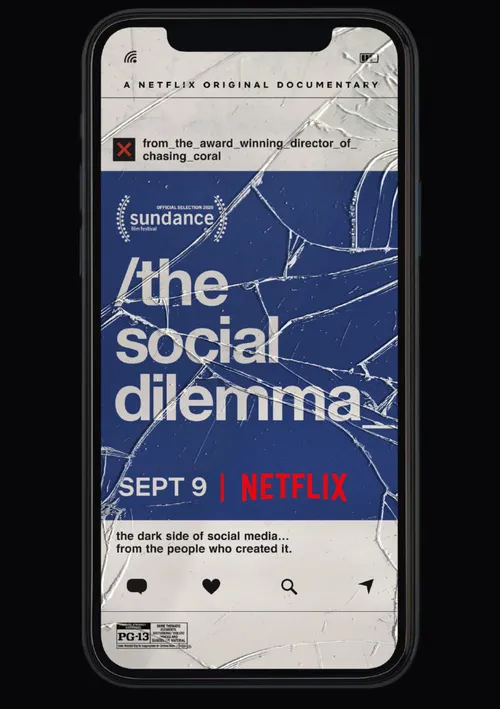
The Social Dilemma IS WOKE
This documentary-drama hybrid explores the dangerous human impact of social networking, with tech experts sounding the alarm on their own creations.
Set in the dark underbelly of Silicon Valley, "The Social Dilemma" fuses investigative documentary with enlightening narrative drama.
Expert testimony from tech whistle-blowers exposes our disturbing predicament: the services Big Tech provides--search engines, networks, instant information, etc.--are merely the candy that lures us to bite. Once we're hooked and coming back for more, the real commodity they sell is their prowess to influence and manipulate us.
Oops! Is this show WOKE?
Only an account holder or member can file. Cite a scene, a line, or a pattern. Other account holders +1 or −1 that argument, once each. The show is not IS WOKE until enough of them have given a +1. Enough −1s remove the write-up, and it is no longer shown.
Sign in to file a woke label. One of each criterion per member.
Comments and reviews
Report a mistake
Same rule as woke labels: one report, a written reason, and the community +1 or −1 it — once per member. A net +5 applies the change. Editors can hold it for review, or apply it immediately.
No mistake reports yet.
Sign in to report a mistake. One report per field, per member.
Member review
Peg Harlan
Sep 24, 2026
8/10I have never been much for the whole social media carousel. Friends still give me a hard time about it. No accounts, cookies off wherever I can manage it, and I dig through the vendor lists on sites just to shut down the “legitimate interest” nonsense. After sitting through The Social Dilemma I started wondering whether there is any clean way left to stay outside the reach of that whole machine and its advertising and training models. The film lays out how the free services are the bait and the real product is the ability to steer what people see, feel, and do next. That part lands. It is a hybrid, half talking heads from people who helped build the platforms and half dramatized sequences that try to show a family getting pulled under by the feeds. The experts are the stronger half. They know the systems from the inside and they are not shy about saying the design is meant to keep you scrolling, keep you reacting, keep you coming back. Addiction, polarization, the way attention gets harvested and sold—those are not abstract worries once you hear the people who wrote the code describe the incentives. The drama side is thinner. It reaches for a sci-fi villain look when the actual problem is quieter and more ordinary: screens full of data, A/B tests, and growth targets. I kept wishing they had just filmed the real dashboards and meeting rooms instead of dressing the manipulation up like something out of a neon thriller. The evils of hijacking human attention do not need the costume. The documentary can feel a little too pleased with its own cleverness. It knows it is delivering a warning and sometimes the delivery turns self-righteous. You may still pick up useful pieces, but the framing occasionally tips into lecture. That said, the core observation holds. These companies figured out how to turn everyday connection into a behavioral laboratory, and most of us walked in without reading the fine print. I do not need a moral panic to accept that the tools were built to maximize engagement first and consider the human cost later. The film is one-sided by design—it is whistleblowers and critics, not a boardroom defense—and that narrowness is both its strength and its limit. It does not pretend to be balanced. It wants you to look at your own habits and decide whether the trade is worth it. What stayed with me is the simple mechanics more than the apocalyptic tone. Recommendation engines that learn what keeps you agitated. Notifications timed to interrupt whatever you were doing. Metrics that treat a teenager’s mood swing as a retention opportunity. None of that requires a conspiracy; it only requires profit motives and clever engineering. I have watched enough of these platforms from a distance to recognize the pattern without needing the dramatized family meltdown to sell it. Still, the hybrid format keeps the runtime from turning into a pure lecture, and the faces of the people who once believed they were connecting the world give the warnings weight. They are not outsiders throwing stones. They are people who helped pour the foundation and then walked away uneasy. I rated it four stars because it does the job it sets out to do without collapsing into pure panic or pure sermon. It is not subtle, and the cute self-awareness can grate, but the underlying claim is solid enough that I finished it more careful about the few digital corners I still touch. You do not have to swear off every screen to take the point. You just have to notice when the free service is actually charging you in attention and mood. The film makes that trade-off hard to ignore. For anyone who has ever felt the pull of the infinite scroll or watched a conversation turn ugly because an algorithm decided outrage travels farther, the pieces fit together cleanly. It could have shown more of the actual offices and less of the stylized control room, and it could have dialed back the knowing tone, yet the substance is there. I walked away still preferring my quiet setup, cookies blocked and accounts nonexistent, and a little more convinced that staying outside the ambit is worth the occasional inconvenience. They used to make tools that stayed tools. This one shows how the current batch decided to become something else.