
 TV
 VIDEO GAMES
 PODCASTS
 VIDCASTS
 STAND-UP
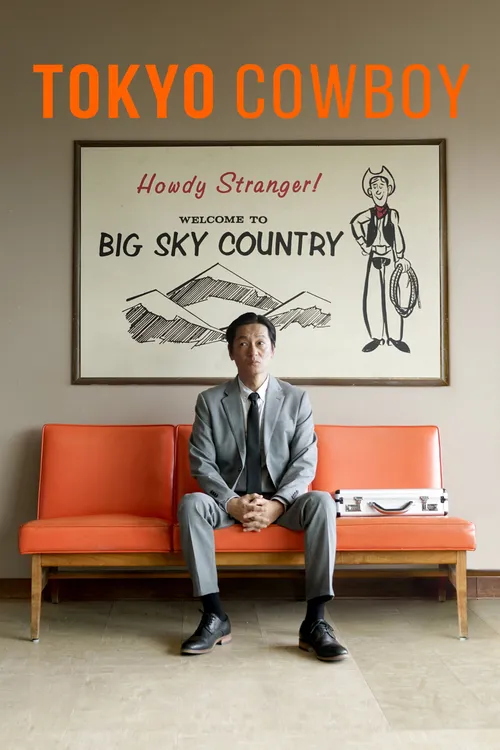



 MOVIE · 2024
Tokyo Cowboy
A Japanese businessman goes on an unwitting journey of self-discovery when he takes a company trip from Tokyo to a Montana cattle ranch.
Japanese corporate turnaround artist, Hideki is confident that he has the secret sauce to recharge any stagnant brand, he's got a slick pitch deck (with a snapshot from his own childhood), and he's engaged to the corporate vice-president he reports to.
His company is about to liquidate a money-hemorrhaging cattle ranch in Montana, when he parachutes in for a quick fix. His Japanese beef consultant goes hilariously native, and Hideki, a smart guy, immediately sees that his idea for a quick fix was mistaken. Now unsettled and off the grid in an alien culture, Hideki recalibrates his values and his life goals.
Oops! Is this show WOKE?
Only an account holder or member can file. Cite a scene, a line, or a pattern. Other account holders +1 or −1 that argument, once each. The show is not IS WOKE until enough of them have given a +1. Enough −1s remove the write-up, and it is no longer shown.
Sign in to file a woke label. One of each criterion per member.
Comments and reviews
Report a mistake
Same rule as woke labels: one report, a written reason, and the community +1 or −1 it — once per member. A net +5 applies the change. Editors can hold it for review, or apply it immediately.
No mistake reports yet.
Sign in to report a mistake. One report per field, per member.
Member review
Wes Calder
Oct 6, 2026
7/10Tokyo Cowboy sits in that middle space where a premise could easily go broad or preachy and instead just stays with the guy who made the bet. Hideki is a Tokyo executive who talks his company into letting him fix a failing Montana cattle ranch. He arrives with Wagyu methods and the usual corporate certainty that process will bend the place to his will. The expertise he counted on does not hold, and he is left standing in actual dirt with a herd that does not care about his timeline and locals who have seen outsiders before. I gave it 3.5 because it keeps its feet under it longer than the setup suggests. The early stretch is the strongest part. You watch him try to impose order on something that runs on weather, feed costs, and animals that ignore spreadsheets. The friction is practical rather than cartoonish. He does not instantly become a cowboy or get mocked into submission. He just keeps running into the gap between the plan he sold and the work the ranch actually requires. That collision feels earned. The film does not hurry him toward a soft-focus epiphany; it lets the setbacks accumulate until he has to adjust or fail out loud. The ranch itself is treated as a working place rather than a scenic backdrop for self-discovery. You get the routines, the equipment, the quiet calculations of whether the numbers can ever close. Hideki’s Japanese background is present without being turned into a constant joke or a lecture. His habits and expectations clash with the Montana operators, but the movie mostly lets the difference sit there instead of scoring points off it. When he starts to change, it is less about shedding some stereotype and more about realizing that the missing piece was not another consultant. He had to stop managing from the outside and start answering to the same daily pressures everyone else already lived with. That said, the arc is still visible from a distance. Once the corporate noose tightens and the personal stakes rise, the stations of the story arrive on schedule. There is the pressure call from Tokyo, the moment where pride has to give way, the gradual respect from the people who were skeptical, and the quiet sense that the land has taught him something his boardroom never required. None of it is badly handled. It just does not surprise. You know roughly where the needle will land by the midpoint, and the film does not invent new complications to keep you guessing. It trusts the basic fish-out-of-water shape and fills it with solid enough detail. Performances stay in the same restrained register. The lead carries the shift from brash certainty to something more tentative without grand gestures. You believe he could have talked a company into this project, and you also believe the same man would look slightly lost when a cow does not cooperate. The supporting ranch characters avoid the worst versions of the crusty local. They have their own interests and limits. They are not waiting around to be enlightened or to enlighten him on cue. That helps. A couple of the corporate scenes back in the Japanese office feel a little thinner, more functional than lived-in, but they do the job of keeping the clock ticking on his career risk. I have no deep connection to cattle ranching, but the film made the physical and financial grind feel specific enough that I did not feel lectured. It is not romanticizing the open range or condemning the outsider who thinks he can improve it. It simply shows a man discovering that the asset he promised to turn around has its own logic, and that logic includes him if he is willing to meet it halfway. The wry part is watching someone who is used to controlling variables learn that some of them cannot be controlled, only endured and worked around. That lands without speeches. Where it settles into the 3.5 range rather than higher is the familiar back half and a certain evenness of tone that never quite spikes into something memorable. It is competent, occasionally pointed, and free of the urge to turn every cultural difference into a morality play. I did not walk away thinking I had seen a hidden gem, but I also did not feel my time had been spent on empty motion. It does what it sets out to do with a straight face and a decent sense of place. For a story about a man betting his career on a ranch he does not yet understand, that is enough to keep it honest. I would not rush to watch it again tomorrow, yet I also would not talk someone out of putting it on if the premise already interested them. It earns its hours without overclaiming them.