
 TV
 VIDEO GAMES
 PODCASTS
 VIDCASTS
 STAND-UP
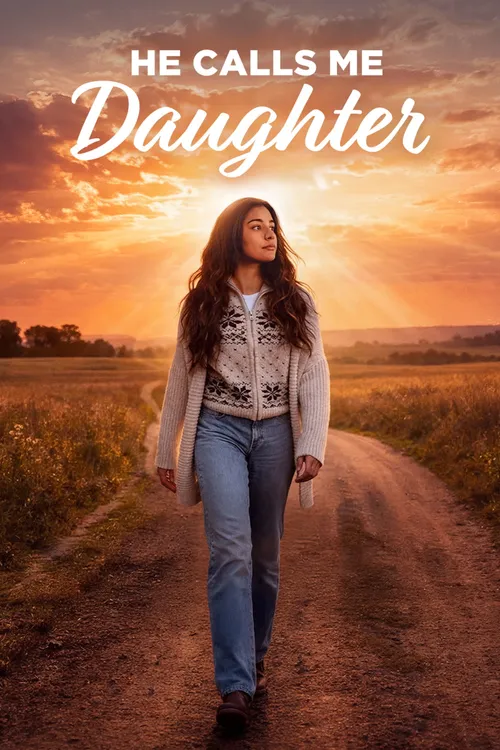



 MOVIE · 2026
He Calls Me Daughter
Women marked by absent or broken fathers find healing, courage, and restored identity through God’s faithful love in raw personal stories that affirm a heavenly Father changes everything.
He Calls Me Daughter follows women whose lives were shaped by absent or broken fathers as they confront long-standing wounds and begin seeking restoration. The documentary gathers their raw accounts of loss, abandonment, and fractured identity, showing how those experiences left lasting marks on courage and self-worth. Each woman turns toward the Christian claim of a heavenly Father whose love remains steady when earthly fathers failed. Through testimony and reflection the film traces the move from pain toward healing, emphasizing prayer, faith, and the recovery of dignity. Viewers watch the subjects name their stories honestly while discovering that divine faithfulness can rewrite the narrative of who they are. The early passages establish the common thread of father absence and the first steps of spiritual encounter that open the door to change.
As the stories deepen, the women describe concrete moments of courage when they choose to trust God’s love over the old patterns of rejection. Relationships with family and community shift as restored identity takes root and they practice living as daughters rather than as orphans of the heart. The film stays with their ongoing process—setbacks, newfound strength, and the quiet work of forgiving what was broken—without turning the accounts into lectures. Later passages highlight how the same faithful love that met them in pain continues to steady everyday decisions and future hope. By the close, the subjects stand in the truth the documentary sets out to reveal: a heavenly Father redefines belonging and purpose. Their journeys remain grounded in personal testimony rather than abstract ideology.
Click any of the following icons below to rent or stream it!
Oops! Is this show WOKE?
Only an account holder or member can file. Cite a scene, a line, or a pattern. Other account holders +1 or −1 that argument, once each. The show is not IS WOKE until enough of them have given a +1. Enough −1s remove the write-up, and it is no longer shown.
Sign in to file a woke label. One of each criterion per member.
Comments and reviews
Report a mistake
Same rule as woke labels: one report, a written reason, and the community +1 or −1 it — once per member. A net +5 applies the change. Editors can hold it for review, or apply it immediately.
No mistake reports yet.
Sign in to report a mistake. One report per field, per member.
Member review
Omar Quill
Sep 19, 2026
8/10I ended up watching He Calls Me Daughter after a long session that went nowhere useful. I’d been stuck on a boss for like two hours, tweaking a build that still fell apart in the second phase, and my head needed a break from the same loop. This movie isn’t anything like that world, but it stuck with me in a quieter way than most story-driven games do. It’s built around real women talking about fathers who weren’t there, or who were there in body but not in any way that counted. Absent, distant, or just wounding in the slow everyday sense. The film doesn’t dress it up or turn it into speeches. You hear the specific gaps—how a kid learns early that safety and belonging are questions instead of facts, and how those questions hang around into adult life. Value feels conditional. You second-guess whether you’re worth claiming. I don’t have that exact history, but I’ve seen versions of it in people around me, and the way the movie lets the women name it without turning the pain into a spectacle felt honest. No big dramatic reenactments. Just the accounts and the space they take up. What surprised me is how steady it stays on the longing side of things. It’s not only about the wound. There’s this clear undercurrent of wanting to be seen and claimed by someone who doesn’t flinch. The film follows that longing instead of rushing past it. I play a lot of games where belonging is the whole point of the faction or the party or the guild hall, and you feel the difference when a character is written like they actually need it versus when it’s just flavor text. This movie treats the need as real. The women talk about identity getting shaped around the missing piece, and you can feel how that shapes choices later—who you trust, what you settle for, how hard you work to prove something. Faith isn’t bolted on at the end like a patch note. The stories walk toward Christ and the idea of a perfect Heavenly Father as the place where the repair actually happens. Worth gets redefined there instead of through endless self-work or waiting for the earthly father to finally show up right. I’m not the guy who usually sits through faith-centered stuff, but the way it’s handled here didn’t feel preachy or forced. It felt like the natural direction the testimonies were already pointing. The women aren’t presented as projects; they’re people who found a different kind of claiming. That part landed cleaner than I expected. It doesn’t pretend the old hurt vanishes overnight. It just holds that there’s a Father who doesn’t leave the same gaps. I gave it four stars because it does what it sets out to do without wasting time on theory or trying to be everything at once. The runtime stays focused on the voices. A couple of stretches move slower than I’d like—moments where the same emotional ground gets covered again from a slightly different angle—and I caught myself checking the clock the same way I do when a cutscene overstays after a tough fight. That’s the only real ding. Everything else holds together. The editing keeps the testimonies clear. You never lose track of whose story you’re in. And the hope side doesn’t feel cheap. It grows out of the ache instead of papering over it. Watching it after grinding failed attempts at a boss made the contrast sharper. In games you can reload, respec, farm the materials, and force the win through repetition. Real father wounds don’t give you that reset button. The movie understands that and still points somewhere solid. I’ve thought about it more than once since, usually when I’m mid-build and my mind drifts. Belonging and worth aren’t loot drops. The film treats them as things that get restored through something bigger than the original rupture. That tracks with how the women describe moving forward. I’m not changing my whole watchlist or anything, but this one earned the four. It’s straightforward, personal without being messy for effect, and it doesn’t apologize for where the healing comes from. If you’ve ever sat with the quiet versions of those questions—about value, about whether anyone’s actually in your corner—it gives them room and then walks them somewhere better. That’s rarer than it should be. I’ll probably recommend it to a couple friends who don’t mind sitting still for something that isn’t trying to entertain every second. For a night when the controller needs to stay down, it worked.