
 TV
 VIDEO GAMES
 PODCASTS
 VIDCASTS
 STAND-UP
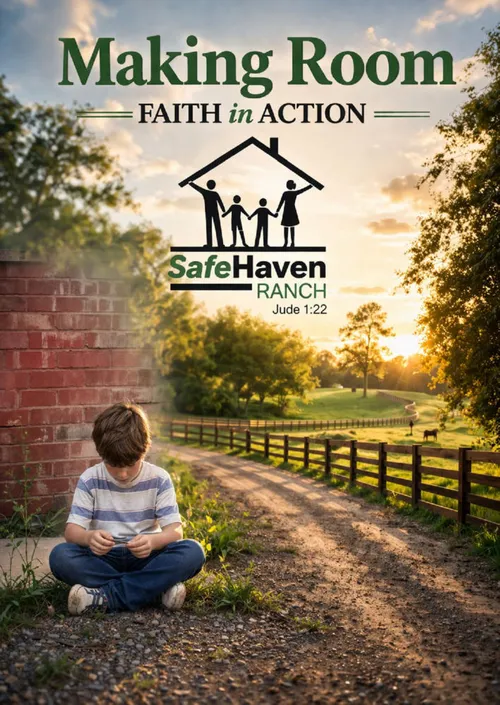



 MOVIE · 2026
Making Room Faith in Action
Safe Haven Ranch is a private community of homes where children can grow, learn, and excel in a Christian environment so they can make a positive impact for the Kingdom of God.
Making Room: Faith in Action shines a light on Safe Haven Ranch, a private Christian residential community dedicated to saving and nurturing children who are victims of difficult family or life circumstances. Rooted in the biblical calling to care for the vulnerable, the narrative focuses on the unglamorous yet deeply meaningful daily work of house parents and staff who actively live out their faith.
By documenting the organization’s years of hardship, perseverance, and triumph, the film illustrates how providing a stable environment with structured biblical values can completely reshape a child’s future.
Click any of the following icons below to rent or stream it!
Oops! Is this show WOKE?
Only an account holder or member can file. Cite a scene, a line, or a pattern. Other account holders +1 or −1 that argument, once each. The show is not IS WOKE until enough of them have given a +1. Enough −1s remove the write-up, and it is no longer shown.
Sign in to file a woke label. One of each criterion per member.
Comments and reviews
Report a mistake
Same rule as woke labels: one report, a written reason, and the community +1 or −1 it — once per member. A net +5 applies the change. Editors can hold it for review, or apply it immediately.
No mistake reports yet.
Sign in to report a mistake. One report per field, per member.
Member review
Dan Reilly
Sep 30, 2026
5/10Making Room Faith in Action sets out to show Safe Haven Ranch as a private community of homes built so kids can grow up with house parents who keep Biblical values at the center. The premise is straightforward: years of struggle, people showing up when they were needed, and faith treated as something you do rather than something you announce. I came in ready for that story. What I got first was a movie that never quite decides how to put it on screen. The early stretches drag. Scenes of daily life on the ranch sit there without much shape. You see the homes, the kids, the adults trying to hold it together, but the camera and the editing do not give those moments a clear reason to exist beyond proving the place is real. A documentary-style piece can live on that kind of plain observation, yet this one keeps circling the same points about perseverance and provision without tightening the focus. I kept waiting for a sharper through-line—one child’s path, one house parent’s decision, one concrete crisis that forced the community to change—and it stayed general longer than it should have. When the film does lean on testimony, the delivery often feels staged for the lens rather than pulled from ordinary conversation. That undercuts the claim that this is simply people putting faith into practice. If the work is as hard and daily as they say, the movie needed more of the friction and less of the polished summary. Pacing is another problem. Long stretches of well-meaning talk sit next to brief cuts of kids learning or playing, and the balance never settles. I am not asking for manufactured drama. I am asking for structure. Without it, the central idea—that God supplied the right people at the right time—lands as a repeated assertion instead of something you watch unfold. The production itself looks modest, which is fine for the subject, but the sound and the lighting sometimes call attention to the limitations rather than disappearing into the story. A few sequences feel like they were assembled because the footage existed, not because they advanced anything. That is the part that did not work for me: sincerity without craft still leaves you checking the clock. Credit where it belongs, though. Once the film settles into the actual purpose of the ranch—giving children who have been failed by their circumstances a stable Christian home—the material has weight. House parents are shown trying to keep the focus on the kids rather than on themselves. The environment is presented as intentional: a place meant to let children learn, grow, and eventually make some kind of mark for what the people there call the Kingdom of God. You do not have to share every theological assumption to recognize that the adults on screen treat the work as costly and ordinary at the same time. The movie is clearest when it stays with that practical side—routines, correction, second chances, the slow business of making a home for someone who did not have one. Those passages feel less like a brochure and more like a record of people who decided the ranch mattered enough to keep going through the lean years. I also noticed the film avoids turning the children into props for a larger culture fight. It stays inside the community’s own terms. That choice keeps the piece from collapsing into slogans. When it describes saving kids who are victims of their circumstances, it mostly means the daily grind of housing, teaching, and guiding them under a shared set of beliefs. The restraint helps. It would have been easy to dress the whole thing up as a statement against everything outside the gates. Instead it mostly just shows the gates, the houses, and the people who live there. For viewers who already care about this kind of work, that will be enough. For everyone else, the lack of sharper storytelling will still be the barrier. By the end I respected the effort more than I enjoyed the movie. The subject is real enough: a private ranch built so house parents can concentrate on children inside a Christian frame. The people involved clearly believe they are answering a call rather than running a program. What the film never fully solves is how to turn that belief into something watchable for two hours without repetition and soft edges. A tighter cut, fewer repeated claims about timing and provision, and more patience with the unspectacular days would have helped. As it stands, Making Room Faith in Action is sincere, limited, and only partly successful at the one job it set for itself—making the work visible without sanding it smooth. I am glad the ranch exists for the kids who need it. I just wish the movie had trusted the ordinary details more and the summary language less. That gap is what kept it from rising above a middling watch for me.