
 TV
 VIDEO GAMES
 PODCASTS
 VIDCASTS
 STAND-UP
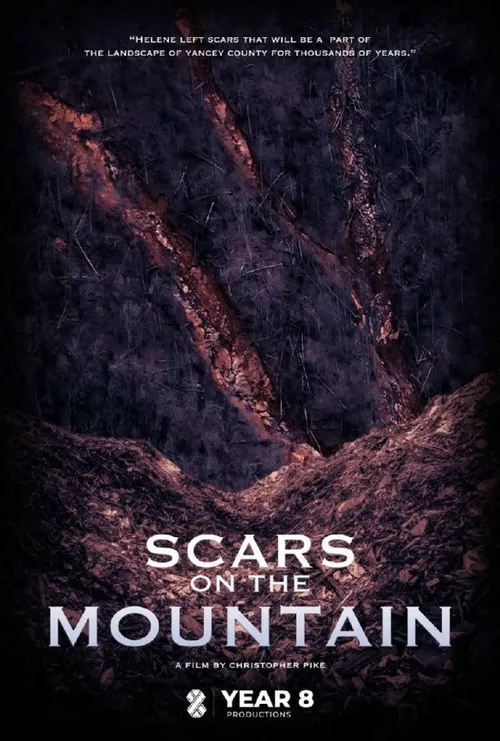



 MOVIE · 2026
Scars on the Mountain
Residents of North Carolina’s mountain communities confront the lasting wreckage of Hurricane Helene after the storm stalls inland and floods the land around Mount Mitchell.
Scars on the Mountain follows the people of Yancey County as Hurricane Helene stalls over North Carolina in late 2024 and unleashes catastrophic inland flooding around Mount Mitchell. Homes, roads, and bridges vanish under sudden torrents while isolated hollows lose power and contact with the outside world. Survivors pick through mud-choked debris fields that once held farms and small businesses. Local crews and neighbors begin the first hard days of clearing wreckage with whatever tools remain. The camera stays with ordinary families as they register the scale of what the mountains have lost and start the slow work of accounting for the living and the missing.
In the weeks that follow, the same communities organize mutual aid, temporary shelters, and supply lines while state and federal help arrives in fits and starts. Residents walk the scarred ridgelines and creek beds that now define their changed landscape, recounting nights of rising water and the decisions that kept them alive. Rebuilders salvage lumber, restore washed-out driveways, and mark the places where landmarks stood. The film tracks how memory of the storm settles into daily life—etched into the ground and into the people who refuse to leave. Strength shows itself in quiet persistence rather than speeches as Yancey County begins the long return to something like home.
Click any of the following icons below to rent or stream it!
Oops! Is this show WOKE?
Only an account holder or member can file. Cite a scene, a line, or a pattern. Other account holders +1 or −1 that argument, once each. The show is not IS WOKE until enough of them have given a +1. Enough −1s remove the write-up, and it is no longer shown.
Sign in to file a woke label. One of each criterion per member.
Comments and reviews
Report a mistake
Same rule as woke labels: one report, a written reason, and the community +1 or −1 it — once per member. A net +5 applies the change. Editors can hold it for review, or apply it immediately.
No mistake reports yet.
Sign in to report a mistake. One report per field, per member.
Member review
Omar Quill
Sep 19, 2026
8/10I put on Scars on the Mountain after a long stretch of grinding endgame stuff in a survival craft game where the map floods if you mess up the weather systems, and somehow this documentary hit harder than any of those scripted wipe scenarios. It’s about Hurricane Helene locking in over the mountains in late 2024 and just unloading on western North Carolina, specifically the Yancey County spots around Mount Mitchell. No big ocean waves crashing into beach towns. Just rain that wouldn’t quit, creeks turning into rivers, hillsides giving out, roads and bridges gone like someone deleted the terrain assets overnight. What worked for me is how close it stays to the people dealing with it right then. Cameras are with first responders and neighbors slogging through mud that swallowed cars and half the living room. You hear the survivors talk about the sound of it—the sudden roar when the debris wall hit—and it doesn’t feel staged. One guy describing how the landmark tree he’d grown up seeing was just… not there anymore. That stuck. I’ve spent way too many hours in games where the environment turns on you and you rebuild from scratch, but watching actual families pick through what’s left of their place after the water dropped makes those save-scum moments feel cheap. The film doesn’t rush past the first stunned days either. It sits with the isolation when the roads are out and help can’t roll in normal. I’m not from the mountains, but I’ve driven through that area on a couple family trips when I was younger, and seeing the before-and-after shots of familiar looking hollows and ridges messed with me more than I expected. The way whole stretches of hillside just slid. You get the sense that these towns were already quiet and spread out, so when the infrastructure went, it wasn’t a city blackout you could walk to the next block and find cell service. It was cut off. The rescue parts feel real—people using whatever boats or ATVs they could get, checking houses that looked empty but might not be. No dramatic music swells telling you how to feel. Just the mud and the quiet after the noise. Later sections shift to the weeks after, when the cameras go back and you see the same folks starting to clear debris or figure out how to get kids to a temporary school setup. That part earned the fourth star for me. A lot of disaster docs either stop at the chaos porn or jump straight to politicians giving speeches. This one hangs around for the boring, exhausting middle where people are still sleeping in whatever dry corner they can find and rationing the supplies that made it through. I kept thinking about how in co-op survival games your group eventually hits that phase where the big threat is over but the base is wrecked and you’re arguing over who crafts what first. Real version is quieter and heavier. No respawn. Pacing is steady without feeling padded. Runtime sits right where it needs to—enough to show the scope without turning into a three-hour slog. Cinematography is mostly handheld and practical, which fits. When they do pull back for wider shots of the damaged slopes around Mount Mitchell, it lands because you’ve already been down in the muck with the residents. Sound design is simple: water, engines, voices. The interviews don’t feel like they were cleaned up for polish. People repeat themselves or trail off the way they would if you were standing there talking to them after a sixteen-hour day of digging. I rated it four because it does the hard thing of staying on the ground without turning the storm into a metaphor for something else. It could have easily slid into lectures about bigger systems or whoever’s to blame for the weather pattern. Instead it just documents what Helene did to these specific communities when it stalled inland and kept dumping rain. That restraint is rare. There are moments where the loss hits hard—buried vehicles, homes that are just foundations now—but it never feels like it’s mining misery for points. You walk away understanding why recovery is going to take years in places where the next nearest town was already a long drive before the bridges washed out. If I have a nitpick, it’s that a couple of the later interview segments circle the same ground a little longer than needed, and I wouldn’t have minded one tighter edit pass there. Still, that’s minor. The core holds. I’ve bounced off plenty of docs that feel like they were made to check a box or push a mood. This one feels like somebody decided the people in Yancey County deserved a straight record of what happened when the mountain creeks stopped being creeks. Watched it in two sittings because I had a raid night in between, and both times I came back to it without that usual “do I really need to finish this” drag. Solid work. Worth the time if you can handle watching real recovery instead of the Hollywood version where everything resolves by the credits.