
 TV
 VIDEO GAMES
 PODCASTS
 VIDCASTS
 STAND-UP




 MOVIE · 2022
Turning Red IS WOKE
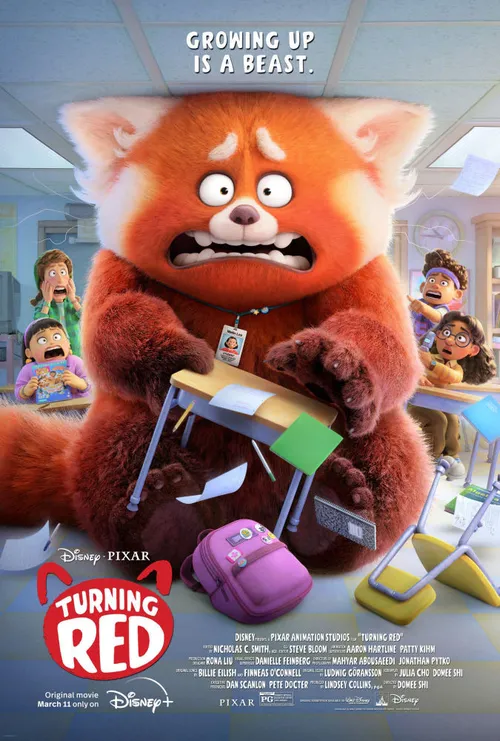
A dutiful Toronto teen discovers she turns into a giant red panda whenever her emotions surge, and she must hide the family curse while chasing a boy-band concert and sparring with her strict mother.
Turning Red follows Meilin "Mei" Lee, a 13-year-old Chinese-Canadian girl in 2002 Toronto who excels at school, helps run the family’s temple dedicated to their ancestor, and stays tightly bonded to her exacting mother Ming. When strong feelings hit, Mei suddenly transforms into a huge red panda because of a hereditary curse passed down the women in her line. She panics, confides in her close friends, and tries to keep the changes secret while still acting like the perfect daughter. Everyday teen pressures—crushes, school, and the pull of a popular boy band—make the outbursts harder to control. Ming’s hovering care collides with Mei’s growing need for space, turning ordinary arguments into high-stakes cover-ups at home and around the city.
Mei and her friends hatch plans so she can attend the 4*Town concert without Ming finding out, using the panda form in ways that both help and complicate their schemes. Family members who share the same curse become involved, and a traditional ritual is prepared that is meant to seal the red panda away for good. Mei must decide whether suppressing the animal will also suppress the parts of herself she is only starting to understand. The clash with Ming peaks as temple duties, ancestral expectations, and Mei’s loyalty to her friends collide in public. By the end Mei and her mother confront what the curse has meant across generations and reach a hard-won understanding about control, love, and growing up.
WHAT CRITERIA MAKES IT WOKE?


WOKE EVIDENCE:
 NOT WOKE SHOWS adminInclusivity Pandering
- The movie ends on “My panda, my choice” — a bodily-autonomy slogan aimed at children.
- Identity and “being yourself” do the work a simpler growing-up story could have done.
- NOT WOKE SHOWS adminSexualized Children
- Thirteen-year-old Mei’s red panda is an on-the-nose puberty/period metaphor; her mom hands her pads in public.
- She lusts after a boy band and a clerk, gyrates to 4*Town, and doodles sexualized crush art in a movie sold to kids.
Oops! Is this show WOKE?
Only an account holder or member can file. Cite a scene, a line, or a pattern. Other account holders +1 or −1 that argument, once each. The show is not IS WOKE until enough of them have given a +1. Enough −1s remove the write-up, and it is no longer shown.
Sign in to file a woke label. One of each criterion per member.
Comments and reviews
Report a mistake
Same rule as woke labels: one report, a written reason, and the community +1 or −1 it — once per member. A net +5 applies the change. Editors can hold it for review, or apply it immediately.
No mistake reports yet.
Sign in to report a mistake. One report per field, per member.
Member review
Lila Marsh
Oct 7, 2026
7/10I went into Turning Red expecting a colorful Pixar-style coming-of-age story set in early-2000s Toronto, and on that basic level it mostly works. Mei is a fun lead—dorky, intense, trying to keep her grades and temple duties and friend group in perfect order—and the animation has that bright, springy energy that makes the red panda transformations pop without feeling cheap. The friend dynamics and the 4*Town obsession feel true to being thirteen in that specific moment. I laughed more than once at the temple scenes and the way her carefully managed life keeps getting wrecked by the panda. It’s entertaining enough that I didn’t check out, which is why I landed at 3.5 instead of lower. That said, the movie kept pulling me out of the story with choices that feel aimed more at making a point than just telling a clean growing-up tale. The red panda itself is about as subtle as a billboard for puberty and periods. When Mei first changes, her mom immediately hands her pads right there in a public moment, and the whole film leans hard into the idea that this big fuzzy creature is her body doing its own thing without her permission. I get the metaphor, but it’s so on-the-nose that it starts to feel like the movie is more interested in explaining adolescence to kids through this device than in letting the character just stumble through it. Mei also has very clear crushes—she lusts after the boy-band guys and a store clerk, doodles sexualized pictures of them, and full-on gyrates when the 4*Town music hits. Fine for a teenage character, but this is sold as a kids’ movie, and those beats sit right next to the period symbolism in a way that felt like it was pushing past what the younger audience needed. The ending sealed the tone for me. After all the family tension and the chaos of trying to hide or control the panda, it wraps with Mei declaring something like “My panda, my choice.” That’s a bodily-autonomy slogan dropped straight into a story for children. It reframes the whole arc as an identity and “be yourself” lesson instead of a simpler story about a kid learning she doesn’t have to be perfect for her mom. The identity framing does the heavy lifting that a straightforward growing-up plot could have handled without the slogan. I noticed it because it lands so deliberately; it’s not just a throwaway line, it’s the note they want you to leave on. Ming’s overprotective intensity is well-acted and grounded in real cultural pressure, but the resolution keeps circling back to Mei claiming the panda as her own personal truth rather than just finding a workable balance. I still enjoyed stretches of it. The Toronto details, the temple work, the way her friends rally around her—all of that has warmth and specificity. The panda design is genuinely funny when it erupts at the worst times. I don’t need every family movie to stay in pure comfort-food territory, and Turning Red has real personality. But the combination of the period metaphor played so literally, the crush stuff and dancing aimed at a young crowd, and that final autonomy tagline made it feel like it was doing two jobs at once: one as a comedy about a girl and her mom, and another as a message piece. The second job kept undercutting the first for me. A cleaner version that trusted the mother-daughter conflict and the sheer awkwardness of turning thirteen without the slogan and the extra identity layer would have sat better. As it stands, it’s good-looking, often funny, and a little too busy making sure you hear the point. That’s why 3.5 feels right—worth seeing if you like the style, but the pointed stuff is impossible to miss once it’s in front of you.