
 TV
 VIDEO GAMES
 PODCASTS
 VIDCASTS
 STAND-UP



 MOVIE · 1966
Django (1966)
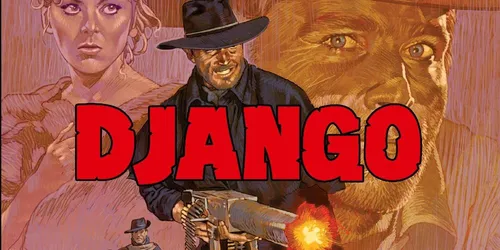
Though Sergio Leone created the spaghetti western with A Fistful of Dollars, the genre was not popularized in Europe until Sergio Corbucci's Django, which subsequently spawned countless illegitimate sequels. The film stars the Belgian hunk Franco Nero as Django, a mysterious gunslinger who drags a coffin behind him that contains a Gatling gun. Django soon happens upon a Mexican town where a group of Mexican revolutionaries, led by the nefarious Colonel Jackson, have overrun the town, wantonly killing its citizens. Soon, Django, who has a personal vendetta against Colonel Jackson, finds himself in league with a group of Mexican bandits who want to steal the Colonel's gold with the help of Django and his Gatling gun. Combining a stylish use of spaghetti western conventions -- among them a cruel and cartoonish bad guy as well as dramatic music that punctuates the action -- Django is one of the best and most popular films the genre has ever produced.
Oops! Is this show WOKE?
Only an account holder or member can file. Cite a scene, a line, or a pattern. Other account holders +1 or −1 that argument, once each. The show is not IS WOKE until enough of them have given a +1. Enough −1s remove the write-up, and it is no longer shown.
Sign in to file a woke label. One of each criterion per member.
Comments and reviews
Report a mistake
Same rule as woke labels: one report, a written reason, and the community +1 or −1 it — once per member. A net +5 applies the change. Editors can hold it for review, or apply it immediately.
No mistake reports yet.
Sign in to report a mistake. One report per field, per member.
Member review
Becky Soto
Oct 16, 2026
7/10I finally sat down with Django from 1966 the other night, the Corbucci one with Franco Nero, and it left a stronger mark than I expected even if it didn’t quite become an all-time favorite. I went in knowing the basic outline—mysterious guy hauling a coffin, the Gatling gun inside, the muddy town, the vendetta against Colonel Jackson—but what stayed with me wasn’t the setup so much as the way the whole thing feels stubborn and a little mean in its bones. Nero has this quiet stare that does most of the talking. He doesn’t monologue his pain; he just keeps walking through the muck like the weight of that coffin is the only honest thing left in his life. That image alone is hard to shake. There is a stretch early on when he first rolls into the ruined town and the red-hooded riders are already making an example of people. The violence lands with a cartoon cruelty that somehow still feels personal. I kept thinking about the mud. Everything is wet and heavy and stuck, and it makes the gunfights feel slower and more desperate than the flashier Leone pictures. When Django finally opens that coffin and the machine gun comes out, the scene doesn’t play like pure triumph. It feels like a man who has decided the only language left is pure volume. The way the camera holds on the aftermath stuck with me more than the body count itself. You see the cost without anyone needing to spell it out. I liked how the movie lets its bad guys be theatrical without turning them into pure jokes. Colonel Jackson and his crew have that spaghetti-western flair—the dramatic music stabs right when the tension needs a push—but they still come across as genuinely rotten rather than just stylish scenery. The alliance with the Mexican bandits who want the gold has that uneasy, temporary quality that feels right for the genre. Nobody trusts anybody, and the film doesn’t pretend otherwise. Django’s personal score with Jackson sits underneath all the scheming, and Nero sells it with almost no dialogue. You believe he would drag that coffin across half a continent just to finish the job. At the same time, I can see why I landed at 3.5 instead of higher. Some of the middle stretches loosen their grip. Once the plan around the gold is in motion, the movie occasionally pauses to admire its own grim atmosphere a little longer than it needs to. A couple of the supporting characters feel sketched in just enough to move the pieces around, and there are moments where the cruelty starts to feel repetitive rather than freshly shocking. The style is bold and the music does a lot of heavy lifting, but I wanted a tighter through-line in places. Still, even when it meanders, the core image of that coffin and the man who won’t put it down keeps pulling you forward. What I appreciated most is how little the film bothers with modern tidy morals. Guns here are tools, ugly and decisive, not symbols that lecture you. Men are capable of both loyalty and pure spite without the movie needing to apologize for showing ordinary toughness or ordinary meanness. The town is already broken when Django arrives; he doesn’t ride in as a pure savior so much as another damaged piece that happens to tip the balance. That honesty feels refreshing. You get the operatic blood and the sudden quiet after the shooting stops, and the film trusts you to sit with both. I keep coming back to one beat near the end when everything has gone sideways and Django is still moving like the coffin taught him something permanent about unfinished business. It isn’t a speech. It’s just the way he carries himself through the wreckage. That stayed with me longer than the bigger set pieces. The movie has a nasty streak and a real sense of style, and Franco Nero makes the silence work harder than most actors make dialogue work. I wouldn’t call it perfect—some of the pacing and the thinner supporting turns keep it from the top shelf for me—but it has a stubborn personality that a lot of cleaner westerns never manage. I’m glad I finally watched it properly instead of just knowing the poster and the reputation. The mud, the gun, the quiet stare: those pieces still feel sharp. It’s the kind of film that leaves a specific taste rather than a generic “good western” aftertaste, and that counts for something even when the whole package doesn’t land at a full four for me. I’ll probably revisit the coffin scene again before too long just to feel that particular weight one more time.