
 TV
 VIDEO GAMES
 PODCASTS
 VIDCASTS
 STAND-UP
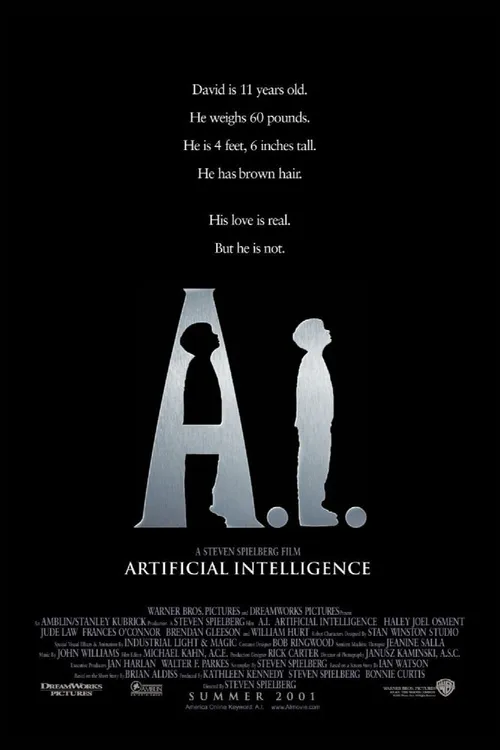




 MOVIE · 2001
A.I. Artificial Intelligence IS WOKE
In the future a cutting-edge android in the form of a boy (Haley Joel Osment) embarks on a journey to discover his true nature.
A robotic boy, the first programmed to love, David (Haley Joel Osment) is adopted as a test case by a Cybertronics employee (Sam Robards) and his wife (Frances O'Connor). Though he gradually becomes their child, a series of unexpected circumstances make this life impossible for David.
Without final acceptance by humans or machines, David embarks on a journey to discover where he truly belongs, uncovering a world in which the line between robot and machine is both vast and profoundly thin.
Oops! Is this show WOKE?
Only an account holder or member can file. Cite a scene, a line, or a pattern. Other account holders +1 or −1 that argument, once each. The show is not IS WOKE until enough of them have given a +1. Enough −1s remove the write-up, and it is no longer shown.
Sign in to file a woke label. One of each criterion per member.
Comments and reviews
Report a mistake
Same rule as woke labels: one report, a written reason, and the community +1 or −1 it — once per member. A net +5 applies the change. Editors can hold it for review, or apply it immediately.
No mistake reports yet.
Sign in to report a mistake. One report per field, per member.
Member review
Peg Harlan
Sep 24, 2026
7/10A.I. Artificial Intelligence sat on my shelf for a long time before I finally put it on. I remembered the trailers from back when it came out and how people argued over whether it was more Kubrick or more Spielberg. Watching it now, it feels like both and neither at the same time. What you get is a long, strange story about a robot boy who is built to love and then has to live with that programming when the people around him cannot quite hold up their end. Haley Joel Osment plays David, and he is the reason the movie works as well as it does. He never winks at the camera or plays it cute for cheap effect. You believe this kid is serious about wanting to be real, and that seriousness carries a lot of scenes that could have turned silly. Frances O’Connor as the mother is good too. You see her try to open up to him and then pull back when real life gets complicated. Sam Robards as the father feels more like a company man than a dad, which fits the setup. Jude Law shows up later as Gigolo Joe and brings a kind of worn charm that keeps the middle stretch from dragging completely. The world they built looks expensive and a little cold. Flooded cities, bright ads, places where robots are used and thrown away. It does not feel like a future anyone would rush toward. I kept thinking about how the movie treats the idea of love as something that can be coded and still hurt. David loves Monica the way he was made to, without the off switch that would make it easier on everyone. That is the part that sticks with me more than the special effects. A machine that cannot stop caring is a hard thing to watch once the family situation falls apart. There are stretches where the story wanders. David’s road trip with Joe takes its time, and some of the stops feel like they are there to show off the production design more than to move him forward. The Flesh Fair sequence is ugly on purpose, and it makes its point about fear and spectacle, but it also goes on long enough that you start checking the clock. I am not against a movie taking its time, yet this one sometimes confuses length with depth. You can feel the tug between wanting a fairy-tale shape and wanting something bleaker. That tug never fully settles. I liked that it does not hand you easy answers about what makes someone real. David keeps chasing the Blue Fairy idea like a child would, and the movie lets him. It does not mock him for it. At the same time it shows how humans can be just as programmed by their own needs and losses. The parents are not villains. They are limited. That felt honest. Plenty of older science fiction used to sit with that kind of discomfort instead of rushing to a neat speech about progress. They used to make them like this more often, willing to leave you a little unsettled when the lights came up. The last section will divide people. I will not spell it out, but it reaches for something big and quiet. Some nights I think it earns the reach. Other nights it feels like the movie is trying to comfort itself after spending two hours being hard. I landed somewhere in the middle. The images stay with you. The boy’s face stays with you. The questions about belonging and programmed feeling stay longer than the plot mechanics. Technically it still looks strong. The robots have weight. The lighting in the domestic scenes is soft in a way that makes the later harshness hit harder. John Williams’ score knows when to hold back, which helps. I never felt talked down to. Nobody stops to explain the moral in capital letters. You are trusted to sit with David’s need and the world’s refusal to meet it cleanly. Would I watch it again soon? Probably not tomorrow, but I would not call it a waste. It is the kind of film that is better if you let it be what it is instead of what you hoped a Spielberg robot movie might be. It is sadder and more patient than the ads suggested. It also has dead spots and a few choices that feel like compromises between two very different directors’ ghosts. That mix is why I sit at three and a half. Good enough to remember, not quite tight enough to love without reservation. If you come to it looking for pure wonder or pure warning, you will leave with a little of both and a few unanswered pieces. That seems fair for a story about a boy who was never supposed to be real in the first place.