
 TV
 VIDEO GAMES
 PODCASTS
 VIDCASTS
 STAND-UP
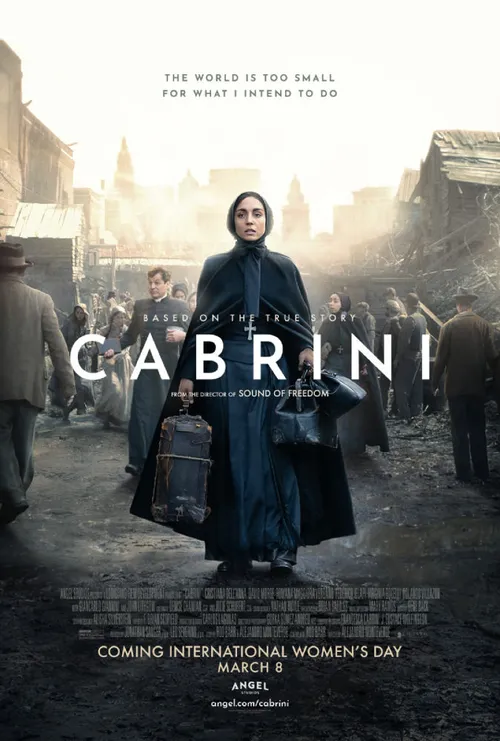



 MOVIE · 2024
(Angel Studios) Cabrini
After witnessing disease and poverty in the slums of New York, Italian immigrant Francesca Cabrini embarks on a daring journey to persuade the hostile mayor to provide housing and healthcare for hundreds of orphaned children.
Francesca Cabrini, an Italian immigrant who arrives in New York City in 1889 and is greeted by disease, crime, and impoverished children.
Cabrini sets off on a daring mission to convince the hostile mayor to secure housing and healthcare for society’s most vulnerable. With broken English and poor health, Cabrini builds an empire of hope unlike anything the world
Oops! Is this show WOKE?
Only an account holder or member can file. Cite a scene, a line, or a pattern. Other account holders +1 or −1 that argument, once each. The show is not IS WOKE until enough of them have given a +1. Enough −1s remove the write-up, and it is no longer shown.
Sign in to file a woke label. One of each criterion per member.
Comments and reviews
Report a mistake
Same rule as woke labels: one report, a written reason, and the community +1 or −1 it — once per member. A net +5 applies the change. Editors can hold it for review, or apply it immediately.
No mistake reports yet.
Sign in to report a mistake. One report per field, per member.
Member review
June Pell
Sep 11, 2026
7/10Alright so Cabrini. I went in knowing basically the poster and that it was Angel Studios which means you’re getting the faith angle straight up, no apology, and I respect that even when the movie itself meanders (and it does meander, oh boy does it meander, the way these period pieces do when they have forty years of a life to cram in and only so many reels). Francesca Cabrini, Italian woman, nun, lands and sees the mess of New York slums, disease everywhere, kids with nowhere, and she decides she’s going to build housing and healthcare whether the city wants it or not, and she has to go toe to toe with this hostile mayor who would rather she disappear. That’s the spine of it. But what stuck with me wasn’t the big confrontations so much as the quiet grit, the way she just keeps showing up day after day with that same set jaw. (I have this habit of watching movies late, like past midnight when the house is quiet and the only light is the TV glow, and this one I started around eleven and finished after one, eyes burning, and I still didn’t pause it, which is rare for me because usually I’ll wander off to the kitchen for water three times and forget what I was even watching.) The production looks solid, not cheap, the costumes and the mud and the tenements feel lived-in without being so grimy you want to look away the whole time. Cristiana Dell’Anna (I mangled the spelling in my head for two days after, kept calling her something else entirely until I checked the credits again) carries a lot on her shoulders, and she has this intensity that doesn’t tip into sainthood porn, you know? She gets tired. She gets angry. There’s a stretch where she’s stuck dealing with the pure paperwork and bureaucracy of the place and I found myself muttering at the screen like I was in the room with her, which is either a good sign or proof I’ve been alone with my opinions too long. Now the draggy parts, because of course. Biopics always hit this wall where they try to check every milestone and the middle hour starts feeling like a list someone wrote on a napkin. Get the building, deal with the rats and the coughing, talk to the local priest, talk to the higher-ups, hop a ship back for more permissions from Rome or wherever (the Vatican bits felt rushed to me, like they wanted the weight of that authority without spending the minutes to let the politics breathe), then back to New York and another meeting. I wished they’d stayed longer with the kids themselves, the orphans, given two or three of them actual little personalities beyond the wide eyes and the wet coughs. Because the disease and the poverty is the whole reason she’s there in the first place, and yet after the opening it kind of settles into background scenery. Circling back to the mayor thing: the hostility is clear, the class stuff, the anti-Italian cold shoulder of the era, and they don’t soft-pedal it into some modern lecture mode, which I quietly appreciated. It stays in its period. Nobody stops the scene to explain why the prejudice is wrong; you just watch it sit there like weather and watch her push through it anyway. I landed on 3.5 because the whole thing never quite grabbed me by the throat the way the best of these faith-and-grit stories can. It’s admirable, it’s sturdy, the idea of faith as action (not just feeling) lands without beating you over the head with a hymn every five minutes, though the faith is obviously there, it’s Cabrini, you can’t sidestep it. There are moments that open up, like when the community starts knitting together around the work, the small victories that feel earned instead of handed down from the score. But then it’ll cut to another planning conversation or another hallway argument and I catch myself checking the phone. (I hate that I do that during movies, it’s my own pet peeve, I tell myself I won’t and then a slow patch arrives and next thing I’m scrolling emails I don’t even care about, pure weakness.) The music sits under everything in a way that sometimes swells right on cue when she’s about to win a point, predictable in that old orchestral way, and I wanted a little more rawness, more silence even. Supporting cast does fine work but nobody really pops except her and maybe the mayor with that classic stone-wall face you want to knock loose. I keep coming back to how long the movie feels even when the actual runtime isn’t outrageous. It’s the kind of film you admire more than you fall for, if that tracks. You walk away thinking yes she was remarkable, the work mattered, the church can still be a force for the ones everybody else steps over when it chooses to roll up its sleeves, and yet you’re not lining up to rewatch it next weekend. Something about these immigrant stories always hits me sideways because my own grandparents came over with nothing and the stories I heard growing up were never glamorous, just hard days stacked on hard days, and this captures some of that hardness without turning the whole thing into misery tourism. The housing and the sickbeds angle stays practical, boots and buckets, not speeches about abstract systems. She just builds. I over-explain this maybe, but the tiny details of how a room gets scrubbed or a cot gets claimed stuck harder than the big mayoral showdowns. Wait, I said I wouldn’t circle back to the mayor again and here I am doing it. The persuasion isn’t magic; it’s stubbornness meeting a crack in the wall, and the film shows both the wins and the personal cost without pretending one woman rewires a city overnight. If they’d trimmed the middle, given the orphans more face time so you felt the stakes in particular faces instead of a crowd, maybe dialed the score back ten percent so the quiet could do more work, I’d be nudging it to a four. As it stands 3.5 feels honest—solid, worthwhile, a little baggy in the center, worth sitting with if you’re in the mood for that old earnest streak Angel leans into without shame. I didn’t come out transformed, but I came out a notch less cynical about what one relentless person can still try to force into existence, and right now that counts for something. The ending lands soft rather than trumpet-blast triumphant, which I liked; real life doesn’t wrap neat with a bow. Anyway I’ve talked myself in a full loop from the slums to the late-night water glass to the score swells to the grandparents’ stories and back again to her tired eyes in that one dim hallway, and that’s probably more than enough looping for one sitting.