
 TV
 VIDEO GAMES
 PODCASTS
 VIDCASTS
 STAND-UP



 MOVIE · 1967
Cool Hand Luke
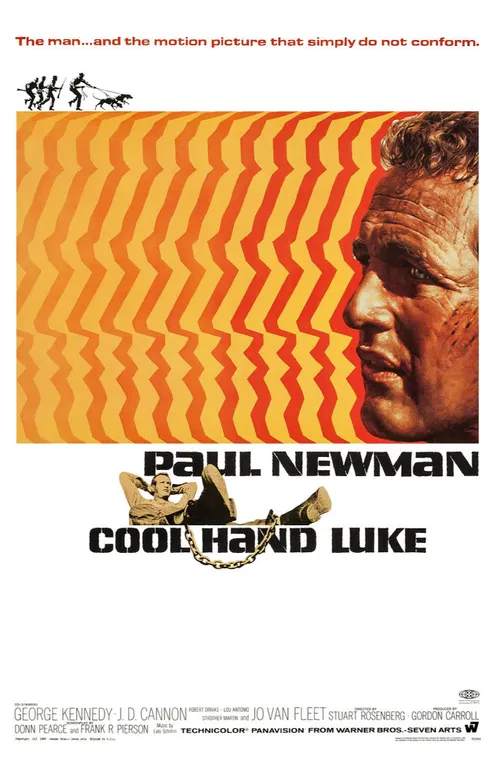
When petty criminal Luke Jackson (Paul Newman) is sentenced to two years in Florida prison farm, he doesn't play by the rules of either the sadistic warden (Strother Martin) or the yard's resident heavy, Dragline (George Kennedy), who ends up admiring the new guy's unbreakable will. Luke's bravado, even in the face of repeated stints in the prison's dreaded solitary confinement cell, "the box" make him a rebel hero to his fellow convicts and a thorn in the side of the prison officers.
Oops! Is this show WOKE?
Only an account holder or member can file. Cite a scene, a line, or a pattern. Other account holders +1 or −1 that argument, once each. The show is not IS WOKE until enough of them have given a +1. Enough −1s remove the write-up, and it is no longer shown.
Sign in to file a woke label. One of each criterion per member.
Comments and reviews
Report a mistake
Same rule as woke labels: one report, a written reason, and the community +1 or −1 it — once per member. A net +5 applies the change. Editors can hold it for review, or apply it immediately.
No mistake reports yet.
Sign in to report a mistake. One report per field, per member.
Member review
Toni Briggs
Oct 2, 2026
8/10Cool Hand Luke still hits because it refuses to apologize for a man who will not bend. Paul Newman plays Lucas Jackson like someone who already decided the world does not get to own him, and the whole picture rides on that simple, stubborn fact. He ends up on a Florida road prison for a drunk night of vandalism, cutting the heads off parking meters, and from the first day you can tell the place is built to grind men down into quiet, useful shapes. Luke will not become one. He grins through orders, takes the beatings, and keeps finding small ways to stay himself. That is the entire engine of the movie, and it still works. I rated it four stars because the film earns its legend without needing to shout. The prison camp feels real in the heat and the dirt and the endless work details. Strother Martin as the Captain is perfect: soft-spoken, smiling, and completely certain that every man can be broken if you apply the right pressure long enough. His line about failure to communicate has been quoted to death, but in context it lands like a quiet threat rather than a catchphrase. The bosses and the rules exist to erase personality. Luke’s crime is that he keeps showing personality anyway. Dragline and the other inmates start watching him the way people watch someone who might actually mean it. They need the example more than they admit. What I respond to is the cost. This is not a cartoon rebel who wins by being clever. Luke pays. Isolation, more labor, the slow tightening of the system around him. Every escape attempt and every act of defiance raises the price. The movie never pretends that stubborn independence is free. It shows the legend forming among the men while the authorities decide he has become too dangerous to leave alone. That tension feels honest. A lot of pictures about nonconformity turn the rebel into a pure symbol. Here the man stays human, tired, still smiling when he should not, and still choosing the hard road. The late sixties were full of people questioning everything that deserved to be questioned, and this film sits right in that current without waving banners. Luke made mistakes and paid for them. Between the hits and the misses he just wanted space to live on his own terms. That is not complicated ideology. It is a man refusing to scrape. In an era when institutions were starting to look brittle and self-important, watching someone keep his spine under a system designed to remove it felt like oxygen. It still does. The movie celebrates that refusal without turning it into a lecture. You feel the heat of the roads, the weight of the chains, and the way one unbroken attitude can spread through a barracks full of tired men. Newman makes it look easy when it is not. The physical comedy of the egg-eating contest, the quiet defiance in the face of punishment, the way he carries exhaustion without surrendering the grin—all of it adds up to a performance that never begs for sympathy. He does not need you to like him. He needs the system to notice it cannot finish the job. George Kennedy as Dragline gives the perfect counterweight: big, loud, initially dominant, then slowly realizing that Luke’s brand of toughness is something he cannot match. Their relationship is the emotional center. The other inmates circle around that shift. You watch loyalty and envy and hope mix together under the Florida sun. I have little patience for films that treat ordinary manhood as the root of every problem. Cool Hand Luke does the opposite. It treats a certain kind of male stubbornness as a form of integrity, even when it is self-destructive. Luke is not a saint. He is not always smart. He is simply unwilling to become property. That distinction matters. The picture never asks you to rewrite history or assign virtue by group. It just puts one man against a machine that demands compliance and lets the friction do the talking. The result is cleaner and harder than most modern stories that try to sell the same idea with speeches. Some stretches linger longer than they need to. The middle of the film settles into the rhythm of the camp a little too comfortably before the next escalation. A tighter cut might have kept the pressure higher. Still, the cumulative effect is strong. By the time things reach their end you understand why the men turn Luke into a story they tell themselves. He became proof that the grind does not always win. That proof is expensive. The movie never hides the bill. Watching it again, I keep coming back to the small refusals. A smile instead of a bowed head. A joke when silence is safer. An escape that everyone knows cannot last. Those moments add up. They turn a two-year sentence into a legend that outlives the man. Cool Hand Luke understands that some people will pay almost anything to remain themselves, and that the rest of us need to see someone do it, even if the ending is not neat. Four stars feels right. It is not flawless, but it is honest in a way that still cuts through the noise. The system wants quiet bodies. Luke keeps answering with a grin. That is enough.