
 TV
 VIDEO GAMES
 PODCASTS
 VIDCASTS
 STAND-UP
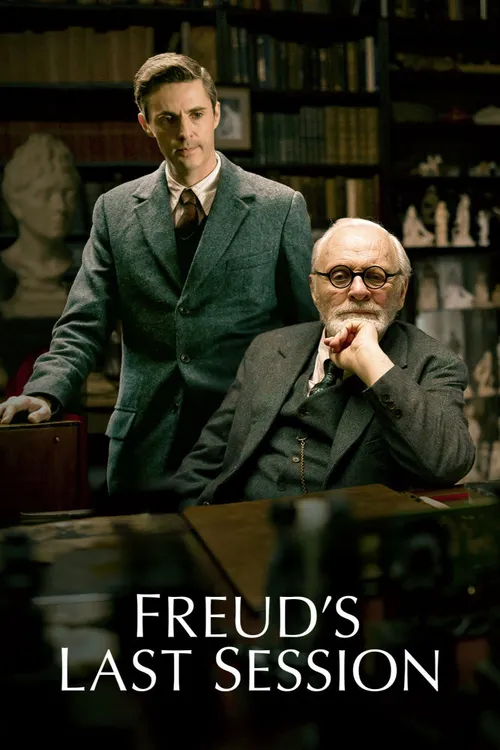



 MOVIE · 2023
Freud's Last Session
Freud invites iconic author C.S. Lewis to debate the existence of God. And his unique relationship with his daughter, and Lewis' unconventional relationship with his best friend's mother.
Set on the eve of WWII and towards the end of his life, Freud's Last Session sees Freud (Hopkins) invite iconic author C.S. Lewis for a debate over the existence of God.
Exploring Freud's unique relationship with his lesbian daughter Anna and Lewis' unconventional romance with his best friend's mother, the film interweaves past, present and fantasy, bursting from the confines of Freud's study on a dynamic journey.
Oops! Is this show WOKE?
Only an account holder or member can file. Cite a scene, a line, or a pattern. Other account holders +1 or −1 that argument, once each. The show is not IS WOKE until enough of them have given a +1. Enough −1s remove the write-up, and it is no longer shown.
Sign in to file a woke label. One of each criterion per member.
Comments and reviews
Report a mistake
Same rule as woke labels: one report, a written reason, and the community +1 or −1 it — once per member. A net +5 applies the change. Editors can hold it for review, or apply it immediately.
No mistake reports yet.
Sign in to report a mistake. One report per field, per member.
Member review
Stu Kline
Oct 6, 2026
6/10Freud's Last Session puts you in a London study in 1939 with Sigmund Freud dying of cancer and C.S. Lewis sitting across from him because the old man wants one more crack at the God question. War is coming. Sirens interrupt. The whole thing runs on talk, pain, and the way belief or the lack of it shapes a life when time is short. Anthony Hopkins plays Freud as a man who is still sharp enough to wound and too sick to hide how much the wounding costs him. The jaw cancer is constant. You see it in how he moves and how he snaps. Matthew Goode’s Lewis is quieter, the recent convert who has already buried enough people to know easy answers are worthless. They go at it on suffering, desire, fathers, the invention of gods. Freud pushes the scientific and the cruel. Lewis answers with longing and the experience of being changed. Neither lands a clean shot that ends the match. That choice feels honest. Real arguments like this rarely produce a winner who walks out converted. The daughter material gives the film its actual pulse. Anna is devoted, already working in the same field, and living under a father who cannot stop directing her. He needs her care and resents the need. She loves him and feels the cage. Those scenes cut deeper than most of the formal debate because they show the theories failing in the one place that should have mattered most. Freud’s control leaks everywhere. Watching him try to manage her future while his own body collapses is more revealing than another round of “is God a wish.” I liked that the movie refuses to crown either man. It circles pain and love and reason without turning the last hour into a victory lap for faith or for atheism. You leave still carrying your own side of the question. That restraint is rare. Too many films on this subject pick a jersey and start cheering. This one keeps both men stubborn and incomplete. The trouble is how stage-bound it stays. You feel the adaptation in the bones. Conversations pause when the script needs air rather than when something inside the characters actually shifts. The outside world of approaching war stays mostly atmospheric. It raises the temperature without forcing either man to change course. Hopkins can do a lot with silence and discomfort, yet the writing does not always give him enough friction beyond Lewis’s steady replies. The ideas arrive, get examined, and move on. They rarely bite hard enough to leave a mark you carry out of the room. Some compression of history is inevitable. Fine. What counts is whether the central clash feels lived-in. Parts of it do. Lewis talking about joy and the sharp ache of wanting something beyond the world lands with real weight. Freud’s insistence on the sheer nastiness of a creation that includes cancer and bombs has force too. Both men have earned their positions the hard way. The film is strongest when it lets those positions collide without tidy resolution and when it remembers that Anna is not just a side character but the living test of everything Freud claims to understand about human beings. I gave it three stars because the performances and the basic seriousness of the material keep it upright. It is worth watching once if the subject pulls you in. You will not feel talked down to. Faith is not treated as a costume for fools, and unbelief is not treated as automatic wisdom. That alone puts it ahead of a lot of louder movies. At the same time it never quite becomes urgent. It remains two intelligent men in a room, handsomely filmed, saying hard things while one of them dies. I wanted more risk that one of them might crack or that the personal cost would finally overwhelm the intellectual game. Instead they hold their ground and the camera records it. The family strain is what stayed with me. The cost of being Freud’s daughter, professional and private, feels specific and true. Everything else is well-spoken and carefully lit but safer than it pretends. For a story built on mortality and the biggest questions, safety is a strange final note. Still, solid craft and two leads who refuse to coast make it better than average. Three stars is the right number. It does the job without ever surprising you into caring more than you already planned to.