
 MOVIES
 VIDEO GAMES
 PODCASTS
 VIDCASTS
 STAND-UP
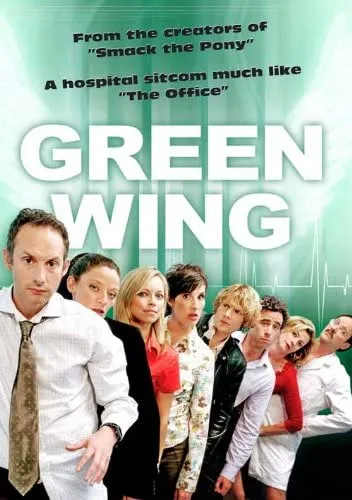




 TV SERIES · 2004
Green Wing IS WOKE
New surgical registrar Caroline Todd stumbles through the chaotic wards of Green Wing Hospital amid a cast of deeply eccentric colleagues. Surreal slapstick and workplace farce drive the series far more than any social lecture.
Green Wing follows Dr Caroline Todd, a newly arrived surgical registrar who turns up dishevelled and under-prepared for her first day and every day after. She immediately collides with the hospital’s oddball hierarchy, including the charming yet unreliable Dr Mac Macartney and the vain, competitive Dr Guy Secretan. Administrative tyrant Joanna Clore rules the office with petty cruelty while staff nurse Sue White lurks with unsettling intensity. Caroline’s attempts at ordinary medicine keep dissolving into physical gags, awkward romances, and non-sequitur set pieces. The series tracks her gradual entanglement with these colleagues as ordinary hospital routines become vehicles for escalating absurdity.
As the seasons continue, Caroline’s tentative relationship with Mac develops alongside Guy’s relentless self-promotion and the staff’s collective inability to behave like adults. Martin Dear’s hapless presence and Alan Statham’s explosive temper add further layers of workplace sabotage and slapstick. Romantic misunderstandings, departmental power struggles, and pure surreal digressions repeatedly interrupt any chance of normal medical procedure. Characters chase personal obsessions through corridors, meetings, and after-hours disasters rather than advancing any ideological agenda. The show remains fixed on the comic chaos of this particular hospital and the people trapped inside it.
Click any of the following icons below to rent or stream it!
WHAT CRITERIA MAKES IT WOKE?

WOKE EVIDENCE:
 NOT WOKE SHOWS adminThe Gay Ratio
- In Series 1, Episode 5, "The Housewarming Party," staff liaison officer Sue White passionately kisses Caroline as Caroline sees off her party guests.
- Sue White, a main character across both series, pursues Caroline romantically and declares, "Maybe I am a lesbian," alongside her relationships with Guy and Mac.
Oops! Is this show WOKE?
Only an account holder or member can file. Cite a scene, a line, or a pattern. Other account holders +1 or −1 that argument, once each. The show is not IS WOKE until enough of them have given a +1. Enough −1s remove the write-up, and it is no longer shown.
Sign in to file a woke label. One of each criterion per member.
Comments and reviews
Report a mistake
Same rule as woke labels: one report, a written reason, and the community +1 or −1 it — once per member. A net +5 applies the change. Editors can hold it for review, or apply it immediately.
No mistake reports yet.
Sign in to report a mistake. One report per field, per member.
Member review
Wes Calder
Oct 21, 2026
8/10Green Wing sits in that odd pocket of early-2000s British comedy where the hospital never quite behaves like a hospital and the staff seem permanently one step away from a nervous collapse or a pratfall. Caroline Todd arrives looking like she slept in her car, which she might have, and immediately gets folded into a workplace that runs on vanity, petty grudges, and sudden physical comedy rather than any serious medical drama. Mac drifts through with that unreliable charm, Guy spends most of his energy preening and competing, Joanna rules the admin side like a small tyrant who thrives on minor humiliations, and Sue White hovers with an intensity that never quite resolves into ordinary friendliness. The show cares more about the next awkward collision or non-sequitur gag than it does about tidy story arcs, which is mostly a strength. I gave it four stars because the slapstick still lands more often than it misses, and the ensemble has a lived-in quality that makes the chaos feel specific rather than generic. Scenes stretch and twist in ways that keep the rhythm off-kilter without turning into pure sketch. Caroline’s attempts at normal procedure keep getting derailed by the people around her, and that friction produces most of the better moments. You can watch an entire stretch of corridor business or an office standoff and feel the writers trusting the performers to sell the weirdness. It rarely lectures. It just lets the farce pile up. That said, I did notice one stretch that pulled me out a little. In the housewarming party episode from the first series, Sue White passionately kisses Caroline while the guests are being seen off. Sue, who is around for both series and already tangled up with Guy and Mac, then pursues Caroline in a more romantic register and at one point declares that maybe she is a lesbian. It is not a subtle beat. The kiss is played with real heat, and the follow-up lines make the attraction explicit. In a series that otherwise thrives on chaotic indifference to ordinary social rules, this particular thread lands with a different weight. It feels less like another eccentric impulse and more like the show deciding to put a same-sex pursuit and an on-screen declaration front and center for a main character. I registered it as the moment the tone briefly shifted toward something more pointed than the surrounding slapstick. Sue’s intensity was already unsettling; folding in the romantic claim and the kiss simply made the agenda harder to miss. Even with that, the surrounding machinery still works. The physical gags stay inventive enough that you forgive a fair amount of repetition. Guy’s vanity continues to generate solid friction, Joanna’s cruelty stays petty in a way that feels accurate to certain office types, and Mac’s unreliability keeps Caroline off balance without ever turning the whole thing into a conventional will-they romance. The surreal edges—those sudden cutaways and deadpan escalations—do more heavy lifting than any message. Most episodes feel like they would rather chase a ridiculous visual or an awkward silence than pause to instruct anyone. That preference is what kept me watching through both series. I am not usually drawn to medical settings, but the decision to treat the wards as a playground for incompetence and impulse rather than a backdrop for noble suffering helps. You get the sense the writers understood that hospitals already contain enough latent absurdity; they simply turned the volume up and refused to apologize for the mess. Caroline remains the nearest thing to an audience surrogate, yet even she gets pulled into the same gravity well of poor decisions and sudden attractions. The show never quite resolves her into a conventional heroine, which suits the tone. If the Sue-and-Caroline material had been the dominant mode, I would have rated it lower. As a single pronounced thread inside a larger farce engine, it registers as an intrusion rather than a total takeover. You can still enjoy the rest of the machinery—the timing of the pratfalls, the way minor characters orbit the main ones with their own private insanities, the refusal to tidy every subplot. Four stars feels right for something that mostly delivers on its own odd terms while occasionally reminding you it knows what year it was made and what boxes were available to tick. I would watch stretches of it again for the pure comic chaos, even knowing that one housewarming sequence sits in the middle of the first series like a deliberate flag. The farce is still the main event. The rest is just the part that made me raise an eyebrow and keep going.