
 MOVIES
 VIDEO GAMES
 PODCASTS
 VIDCASTS
 STAND-UP
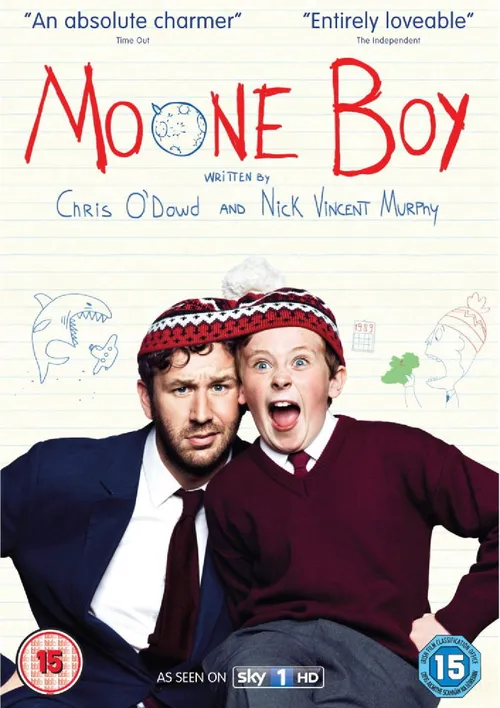




 TV SERIES · 2012
Moone Boy IS WOKE
A boy in 1980s rural Ireland leans on his imaginary friend to survive school, siblings, and a chaotic small-town family. The sitcom plays everyday scrapes for warm, silly comedy rather than lectures.
Moone Boy follows Martin Moone, a quick-witted lad growing up in Boyle with parents Liam and Debra and older sisters Fidelma and Trisha. Martin confides in Sean, the loud imaginary friend only he can see, who eggs him into schemes and pep talks whenever family rows, school pressure, or local oddballs close in. Episodes turn on ordinary 1980s Irish life: church socials, sports days, pocket-money hustles, and the sisters’ dating disasters that spill into the kitchen. Sean coaches Martin through fibs, apologies, and half-baked plans that usually backfire in front of the whole town. The humor stays rooted in the Moone household’s noise and affection, with Martin learning small lessons without the show pausing for speeches.
As the series continues, Martin’s bond with Sean steers him through bigger family shifts—parental arguments, a sister’s engagement drama, and the fear of looking foolish in front of classmates. Liam’s stubborn pride and Debra’s practical warmth keep the house spinning while Fidelma and Trisha chase their own exits from small-town limits. Martin tries to impress friends, dodge chores, and understand adult rules that never quite make sense, always with Sean at his shoulder offering terrible or brilliant advice. Later stretches still circle the same streets, pubs, and school corridors, letting the imaginary friendship carry the comedy instead of outside messaging. The story stays with Martin’s coming-of-age scrapes and the Moones’ noisy loyalty to one another.
WHAT CRITERIA MAKES IT WOKE?

WOKE EVIDENCE:
 NOT WOKE SHOWS adminAnti-Religious Bias
- In Season 1, Episode 5 ("Godfellas"), the parish altar boys run a made-up "altar boy mafia" built on theft and intimidation. The invented priest, Father Linehan, is afraid of them, and the daughter's church involvement is played for laughs.
- The series repeatedly crosses the line with crucifix and Eucharist jokes.
Oops! Is this show WOKE?
Only an account holder or member can file. Cite a scene, a line, or a pattern. Other account holders +1 or −1 that argument, once each. The show is not IS WOKE until enough of them have given a +1. Enough −1s remove the write-up, and it is no longer shown.
Sign in to file a woke label. One of each criterion per member.
Comments and reviews
Report a mistake
Same rule as woke labels: one report, a written reason, and the community +1 or −1 it — once per member. A net +5 applies the change. Editors can hold it for review, or apply it immediately.
No mistake reports yet.
Sign in to report a mistake. One report per field, per member.
Member review
Dan Reilly
Oct 21, 2026
8/10Moone Boy has this soft spot in its bones for the mess of a small Irish town in the eighties, and most of the time that works. What kept poking at me, though, was how casually it treats the church side of that life. In the episode they call Godfellas I watched the parish altar boys run what amounts to a little mafia—shaking kids down, stealing, throwing their weight around—while the made-up priest, Father Linehan, is flat-out afraid of them. The daughter’s church stuff gets treated as pure gag material, and the show keeps slipping in crucifix gags and Eucharist jokes that feel less like gentle ribbing and more like easy targets. It lands as anti-religious bias more than once, and it sits there in the middle of an otherwise affectionate show about family noise. That part didn’t sit right with me; it felt cheap for a series that usually knows better than to punch down at the one institution still holding a lot of these towns together. Once you get past that sour note, the rest of the comedy is warmer and sharper than I expected. Martin Moone is a quick kid who needs his imaginary friend Sean the way some kids need a bike or a secret fort. Sean is loud, pushy, and usually wrong, which means half the schemes end with Martin red-faced in front of the whole kitchen or the schoolyard. The parents, Liam and Debra, argue like real people who still like each other underneath the shouting. The older sisters bring their dating disasters home and dump them on the table like wet laundry. None of it feels written to teach you a lesson; it just sits in the ordinary scrapes of pocket money, sports days, and church socials that somehow still manage to go sideways. I found myself laughing at the small failures more than the big set pieces, which is usually a good sign. The imaginary-friend device could have turned cute or precious, but they keep Sean just abrasive enough that you never fully trust him. He eggs Martin into fibs and half-baked plans, then stands there smirking when the whole thing collapses. That dynamic gives the show its rhythm: Martin tries to look bigger than he is, gets caught, learns a tiny thing, and wakes up the next morning ready to do it again. The town itself feels lived-in without anyone stopping to explain the eighties to you. You just watch the kids hustle for coins, the parents stretch a paycheck, and the local oddballs wander through the frame like they’ve always been there. It never turns into nostalgia porn; it stays closer to the ground than that. I kept noticing how little the show lectures. Most family sitcoms from the last decade can’t resist a speech about kindness or belonging. Moone Boy mostly skips that. When Martin screws up, the correction comes from a slammed door or a sister’s eye-roll, not a monologue. That restraint is what lets the affection come through. You feel the household is chaotic and loud and still the safest place these kids have. Even the sisters’ disasters spill into the kitchen in a way that feels more like love than conflict for its own sake. The humor stays silly without getting mean, except when it turns toward the church material I already mentioned. That exception still bothers me, because the rest of the show is careful about tone. There are episodes that land softer than others. Some of the school pressure plots feel familiar the second they start, and a couple of the local-character bits run long. But the central relationship between Martin and Sean carries the weaker stretches. You can tell the writers know the difference between a joke that comes from character and a joke that just fills time. Most of the time they pick the first kind. The production stays simple—no fancy camera tricks, no over-scored montages—which keeps the focus on the talking and the arguing and the quiet moments when Martin realizes Sean might not be as solid as he hopes. I rated it four stars because the good outweighs the sour. The anti-religious streak in Godfellas and the repeated crucifix and Eucharist cracks are real flaws; they pull you out of the warmth and make you wonder why the writers thought that was fair game when everything else is handled with more care. Still, the everyday comedy of the Moone house, the way Martin survives by leaning on an imaginary loudmouth, and the refusal to turn every scrap into a moral lesson kept me watching. It’s not perfect, and I’m not going to pretend the church jokes didn’t land wrong, but it’s a solid, funny look at a kid trying to grow up in a loud kitchen without losing his mind. If you can sit through the parts that cross the line, there’s a lot here that still works.