
 MOVIES
 VIDEO GAMES
 PODCASTS
 VIDCASTS
 STAND-UP



 TV SERIES · 2022
Sprung
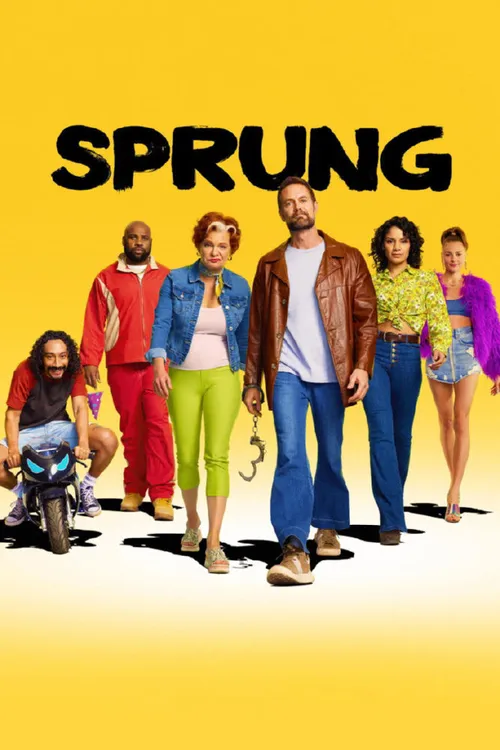
After more than two decades inside, Jack is released early into a locked-down world and has nowhere to live. He shelters with other former inmates who decide to put their criminal skills to work for good.
Sprung follows Jack, a convicted criminal determined to turn his life around after serving more than twenty years. When pandemic policies free him unexpectedly, he walks out with no housing, no plan, and a city under lockdown. He falls in with an unlikely group of fellow former inmates who are equally stranded. Together they improvise a shared shelter and begin testing whether the same expertise that once got them locked up can be aimed at helping people instead. The early episodes track their uneasy trust, the practical chaos of quarantine living, and Jack’s first attempts at a clean slate while the outside world is frozen in place.
As the group settles into their makeshift household, each member’s past and habits collide with the others’. They take on small jobs and schemes that require planning, misdirection, and nerve, only now the targets are problems rather than scores. Jack keeps pushing the crew toward redemption even when old instincts flare and the lockdown rules make ordinary life nearly impossible. Relationships inside the house shift as loyalties are tested and the crew discovers what they will and will not do for one another. The season stays with their day-to-day hustles, the friction of forced proximity, and whether a band of ex-cons can actually stay on the right side of the line.
Oops! Is this show WOKE?
Only an account holder or member can file. Cite a scene, a line, or a pattern. Other account holders +1 or −1 that argument, once each. The show is not IS WOKE until enough of them have given a +1. Enough −1s remove the write-up, and it is no longer shown.
Sign in to file a woke label. One of each criterion per member.
Comments and reviews
Report a mistake
Same rule as woke labels: one report, a written reason, and the community +1 or −1 it — once per member. A net +5 applies the change. Editors can hold it for review, or apply it immediately.
No mistake reports yet.
Sign in to report a mistake. One report per field, per member.
Member review
Omar Quill
Oct 19, 2026
8/10I fired up Sprung after a long stretch of late-night gaming sessions that left me burned out on the same loop of builds and boss attempts. Something about the premise clicked for me right away—a guy named Jack walking out after more than twenty years inside, straight into a world that had basically locked itself down. No housing, no real plan, just the sudden freedom and a city that felt frozen. He ends up crashing with other former inmates who are in the same boat, and they start figuring out how to point their old skills at something useful instead of the usual mess. That setup alone felt different enough from the usual prestige drama or pure comedy grind that I stuck with it. What pulled me in was how the show treats the awkwardness of starting over when everything outside is already weird. Jack is trying for a clean slate while the group improvises a shared place to live, and you can feel the uneasy trust building episode by episode. Nobody is instantly redeemed or magically good at civilian life. They bicker, they mess up the basics of quarantine living, and they test whether the same habits that got them locked up can actually help people. I liked that the early stretch doesn’t rush the bonds. It lets the practical chaos sit there—food runs, space issues, the constant sense that one wrong move could send someone back inside. It reminded me a little of those co-op games where your party has overlapping strengths but zero coordination at first, and you have to learn each other’s timing the hard way. The cast sells the group dynamic without turning it into a cartoon. Jack carries that weight of lost time in a way that feels grounded rather than speechy. The others bounce off him with their own hang-ups and half-baked ideas, and the show finds comedy in the improvisation without undercutting the seriousness of what they’ve all been through. There’s a stretch where they settle into the makeshift setup and start testing those “skills for good” ideas, and some of those sequences land because the show keeps the stakes small and personal. It’s not about saving the world. It’s about whether these guys can keep a roof and not screw over the people around them while the rest of the city is stuck in place. That scale worked for me. I gave it four stars because it holds a solid rhythm most of the way and never feels like it’s lecturing. The pandemic backdrop is just the circumstance they’re dropped into; it doesn’t become the whole personality of the series. You get the lockdown friction, the isolation, the sudden empty streets, and then the story moves on to the characters figuring out what to do with themselves. Some episodes lean harder into the crime-adjacent problem-solving, and those are the ones I rewatched bits of. The group trying to apply old know-how to new problems creates natural tension and a few genuine laughs. It scratches a similar itch to late-game content where you finally have the tools but still have to manage limited resources and trust issues inside the party. Not everything hits at the same level. A couple of middle episodes stretch the living-situation gags a little thin, and one or two side threads feel like they exist mainly to fill time rather than push anyone forward. I wanted a tighter focus on Jack’s adjustment in those stretches. The show sometimes circles the same “can we really change” beat without adding a new wrinkle, and that kept it from a full five for me. Still, when it locks back onto the core group and their half-functional shelter, the chemistry carries it. You start rooting for the small wins—someone landing a useful contact, a plan that doesn’t immediately collapse, a quiet moment where Jack realizes the outside world has moved on without him and he has to catch up anyway. I also appreciated that it doesn’t paint the criminal past as pure cool or pure tragedy. These are people who did real time and still have the muscle memory of how things used to work. Watching them decide to aim that elsewhere feels earned because the show shows the friction. Trust isn’t automatic. Old habits surface at the worst times. The lockdown just forces the issue by removing the usual distractions and escape routes. For a show that could have gone full farce or full misery, it finds a middle lane that stayed interesting across the run I watched. If you’re coming off heavy story games or long multiplayer nights and want something that feels like a fresh start story without the usual polish, this is worth the hours. It’s not trying to reinvent the format. It just puts a handful of stranded people in a locked-down city and lets them bounce off each other until something resembling a second chance starts to form. I finished it feeling like I’d spent time with a crew that actually earned its small victories, and that’s enough for me to rate it solidly. Four stars, no hesitation. I’ll probably circle back to a few episodes when the next long gaming drought hits.