
 TV
 VIDEO GAMES
 PODCASTS
 VIDCASTS
 STAND-UP
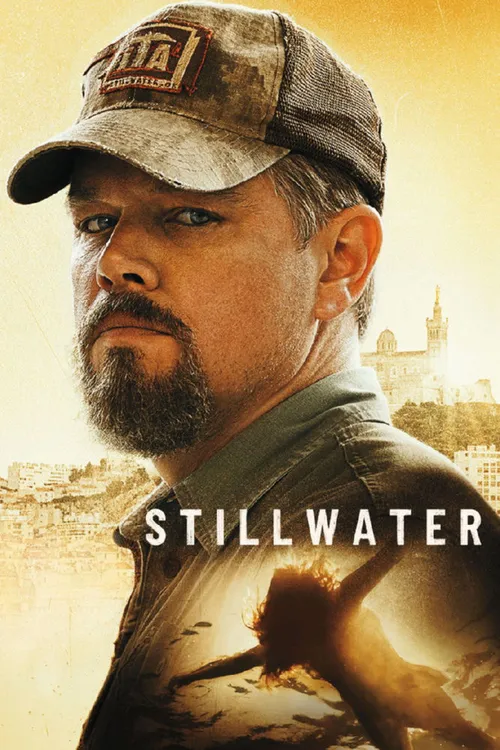




 MOVIE · 2021
Stillwater IS WOKE
A father travels from Oklahoma to France to help his estranged daughter, who is in prison for a murder she claims she didn't commit.
Oops! Is this show WOKE?
Only an account holder or member can file. Cite a scene, a line, or a pattern. Other account holders +1 or −1 that argument, once each. The show is not IS WOKE until enough of them have given a +1. Enough −1s remove the write-up, and it is no longer shown.
Sign in to file a woke label. One of each criterion per member.
Comments and reviews
Report a mistake
Same rule as woke labels: one report, a written reason, and the community +1 or −1 it — once per member. A net +5 applies the change. Editors can hold it for review, or apply it immediately.
No mistake reports yet.
Sign in to report a mistake. One report per field, per member.
Member review
Peg Harlan
Sep 30, 2026
7/10Stillwater sat with me longer than I expected. It is a sad movie in the best sense, the kind that does not flinch from the hard parts of family and distance and the mess people leave behind. I found that refreshing. Too many pictures these days rush past the pain or sand it down into something tidy. This one lets the rough edges stay rough. Matt Damon plays Bill Baker, an oil-field guy from Oklahoma who does not belong in Marseille and knows it. You feel that from the first time he steps off the plane. He is not some movie tough guy posing as a working man. He moves like someone who has spent years with tools in his hands and not much practice talking about feelings. His daughter Allison is locked up over there for a murder she says she did not do, and the two of them have barely spoken in years. That estrangement is the real engine of the thing. The crime mystery is secondary, even if the trail of it pulls him across the city. I have always liked Damon’s quieter work better than the flashy stuff. Here he keeps everything close to the vest. You root for him because he keeps showing up, even when he does not know the language or the rules or how to be a father again. Abigail Breslin matches him as Allison. She is brittle and angry and still somehow hopeful that somebody will finally listen. Their scenes together hurt in a way that feels earned, not manufactured for tears. Then there is the side of the story that sneaks up on you. Bill finds work and ends up around a theater actress named Virginie and her little girl Maya. Camille Cottin is excellent in that part. She does not play the wide-eyed European who teaches the American how to live. She has her own life, her own limits, and she lets Bill into it carefully. The child is precious without ever turning cute for the camera. Those quiet evenings in their apartment give the movie its heart. You start to understand Marseille the way Bill does, street by street, meal by meal. The locations feel lived-in rather than postcard pretty. It has the confidence to take its time. The mix of English and captioned French works better than it has any right to. Nobody stops the story to explain the culture clash. You just watch people bump into each other and either figure it out or fail. That felt honest. Bill is an Okie roughneck dropped into a place that has no reason to make room for him, and the film never pretends otherwise. It is a brutal world in the small ways as much as the large ones. People protect their own. They lie when it suits them. They also offer a spare room and a meal when it would be easier not to. I will say the plot eventually leans on a fairly large coincidence to lock the pieces together. Some will roll their eyes at that. I almost did. But the dialogue stays crisp and the characters stay complicated, so it still holds. You never get the sense the writers are cheating just to reach a tidy finish. And they do not hand you a sappy ending either. What happens feels like the only thing that could have happened given who these people are. That restraint is rare. Watching it, I kept thinking about how long it has been since a movie let a man like Bill simply try. He is not a hero in the cape sense. He is stubborn, limited, sometimes wrong, and still willing to cross an ocean for a daughter who can barely stand him. They used to make more pictures about people like that, ordinary folks carrying more weight than they should have to. Stillwater does not lecture you about what Bill represents or what Oklahoma means or what France owes him. It just puts him on the ground and lets the days accumulate. The ensemble around the main three is solid too. Nobody feels like filler. You get the sense of a whole city turning slightly when a stranger starts asking questions. Some of those questions lead nowhere. Some of them land hard. The film trusts you to sit with the silence between the answers. I came in mostly for Damon and stayed for the way the whole thing breathed. It is not perfect. The coincidence nags a little, and a couple of turns feel a shade too neat once you step back. But the painful things it confronts are real ones: how families break, how pride keeps them broken, how a person can be both guilty of plenty and innocent of the one thing that matters. That mixture is what stayed with me. It is the kind of movie you finish and then sit for a minute before you get up. Not because it wrecked you, but because it treated the wreckage as ordinary human weather. Bill Baker would probably just wipe his hands and go back to work. The film respects that instinct. I rated it 3.5 because the craft and the performances clear a high bar while the story structure occasionally settles for good enough. Still, I am glad I watched it. Sad and lovely is a hard combination to pull off without tipping into either wallow or sentiment. Stillwater mostly keeps its balance, and that is worth something.