
 MOVIES
 VIDEO GAMES
 PODCASTS
 VIDCASTS
 STAND-UP




 TV SERIES · 2024
Ted (TV Series) IS WOKE
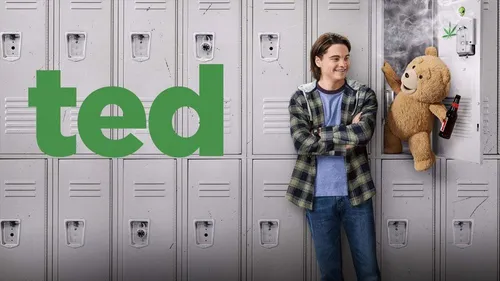
Set in the early 1990s within a working-class Massachusetts suburb, this comedic prequel follows a foul-mouthed, sentient teddy bear whose global fame has faded as he moves back in with his awkward sixteen-year-old best friend and his eccentric family to navigate the raunchy, everyday trials of high school and adolescence.
The narrative takes place between 1993 and 1994 in Framingham, Massachusetts, exploring the formative teenage years of a young boy and his magically animated, walking, talking childhood toy. Now that his brief window of worldwide celebrity has firmly passed, the crude but fiercely loyal teddy bear is forced to attend high school alongside his companion. Together, the inseparable duo tackles the standard hurdles of growing up—including dodging aggressive school bullies, experimenting with marijuana, pursuing romantic interests, and attempting to navigate the complexities of sex education—all while the bear serves as a highly questionable, hilariously corrupting influence.
Beyond their schoolyard misadventures, the storyline delves deeply into the chaotic and divided dynamic of the blue-collar household they share. The boys regularly find themselves caught in the middle of generational warfare between a loudmouthed, aggressively traditionalist father, a pathologically sweet and naive housewife mother, and a fiercely progressive, politically correct college-aged cousin who also lives under their roof. From disastrously botched holiday celebrations and fake ID schemes to wild attempts at marriage counseling and escalating run-ins with local drug dealers, the family routinely hits rough patches, but the tough-talking bear ultimately goes to absurd lengths to stand by his human family.
Click any of the following icons below to rent or stream it!
WHAT CRITERIA MAKES IT WOKE?


WOKE EVIDENCE:
 NOT WOKE SHOWS adminThe Gay Ratio
- The script purposefully constructs its 1993 setting by introducing prominent LGBTQ+ dynamics and relationships into its immediate household circle.
- The narrative explicitly documents John’s live-in cousin, Blaire Bennett, coming out to the family as queer/gender-fluid. The plot heavily highlights her central romantic partnership with her college girlfriend, Sarah. Given the tightly compressed pool of regular characters driving the immediate sitcom domestic arcs.
- NOT WOKE SHOWS adminNormalized Killing
- In Season 2, following a chaotic breakup and a subsequent physical rebound encounter, Blaire navigates an unplanned pregnancy. The episodic narrative loop specifically frames her decision to undergo an abortion as a normalized, standard medical resolution, dedicating narrative side-focus and family dialogue to validating and supporting her choice.
Oops! Is this show WOKE?
Only an account holder or member can file. Cite a scene, a line, or a pattern. Other account holders +1 or −1 that argument, once each. The show is not IS WOKE until enough of them have given a +1. Enough −1s remove the write-up, and it is no longer shown.
Sign in to file a woke label. One of each criterion per member.
Comments and reviews
Report a mistake
Same rule as woke labels: one report, a written reason, and the community +1 or −1 it — once per member. A net +5 applies the change. Editors can hold it for review, or apply it immediately.
No mistake reports yet.
Sign in to report a mistake. One report per field, per member.
Member review
Wes Calder
Oct 7, 2026
7/10I sat through both seasons of Ted on a couple of quiet weeknights when nothing else was on. The setup is simple enough: early nineties Framingham, a working-class house, a sixteen-year-old kid named John who’s still best friends with the same foul-mouthed teddy bear that once had a brief run of fame and now just hangs around getting into high-school trouble. The bear is crude, loyal, and mostly interested in pot, girls, and not getting beat up by the local toughs. That part works in the same low-key way the original movie did. You get the usual awkward dances, the failed schemes, the parents who are half checked-out and half too involved. I laughed a few times, mostly at the bear’s deadpan reactions to ordinary teenage disasters. It never tries too hard to be clever, which I appreciated. What kept pulling me out of it was how the show builds its core household. John’s live-in cousin Blaire Bennett is written straight into the center of the domestic stories. The script has her come out to the family as queer and gender-fluid, then spends a good amount of time on her relationship with her college girlfriend Sarah. In a 1993 Massachusetts suburb the size of the one they’re using, that dynamic sits in almost every kitchen-table scene and living-room argument. It’s not background color; it’s one of the main engines driving the family arcs. With only a handful of regular characters carrying the sitcom weight, the choice stands out. I kept noticing how the period details—the clothes, the music, the mall hangouts—were carefully set, yet the household conversations about identity and partnership felt lifted from a different decade and dropped in without much friction. It undercuts the working-class nineties texture the show otherwise seems interested in. Season two doubles down on the same character. After a messy breakup and a rebound night, Blaire ends up pregnant. The episodes treat the decision to get an abortion as a straightforward medical step. There’s family dialogue around the kitchen table that frames it as the normal, supported resolution, complete with check-ins and quiet validation. No real moral pushback lands inside the story; the narrative just moves through it the way it would handle a broken arm or a bad report card. I sat there watching the bear crack jokes in the next room while the adults calmly walked Blaire through the logistics. It felt like the show wanted credit for being matter-of-fact about something it had already decided was settled. Again, in a tightly wound set of regular characters, that choice takes up real estate that could have gone to the actual high-school mess the premise promised. The rest of the series stays closer to what you’d expect. John fumbles through crushes and tries to keep the bear from starting fights in the cafeteria. There’s a stretch with some cheap weed that goes about as well as those experiments usually do on screen. The bullies are cartoonish but serviceable. The parents have their eccentric bits—nothing that reinvented the form, but enough to keep the house feeling lived-in. I never hated the bear’s voice or the physical comedy of a stuffed animal walking into class. Those scenes land with a shrug and a smirk, which matches the tone I came for. Still, every time the plot circled back to Blaire’s arc, the air went out of the room a little. The show keeps insisting these are just the ordinary trials of adolescence in 1993–94, yet it keeps inserting modern relationship structures and medical resolutions that the rest of the period detail doesn’t support. I ended up at 3.5 because the core buddy energy between the kid and the bear is still intact enough to carry an episode when the writers let it. The crude one-liners about high-school hierarchy and the small-town boredom still work when they stay small. But the deliberate construction of the household around Blaire’s coming-out and her later pregnancy choice sits too heavily on a show that otherwise wants to coast on raunch and nostalgia. It doesn’t ruin the nights I spent watching; it just keeps reminding me the writers had other priorities than the Framingham they claimed to be filming. If you can tune that out, the rest is decent background noise for a couple of evenings. I didn’t turn it off, and I didn’t go looking for a third season either. That feels about right for what it is.