
 MOVIES
 VIDEO GAMES
 PODCASTS
 VIDCASTS
 STAND-UP
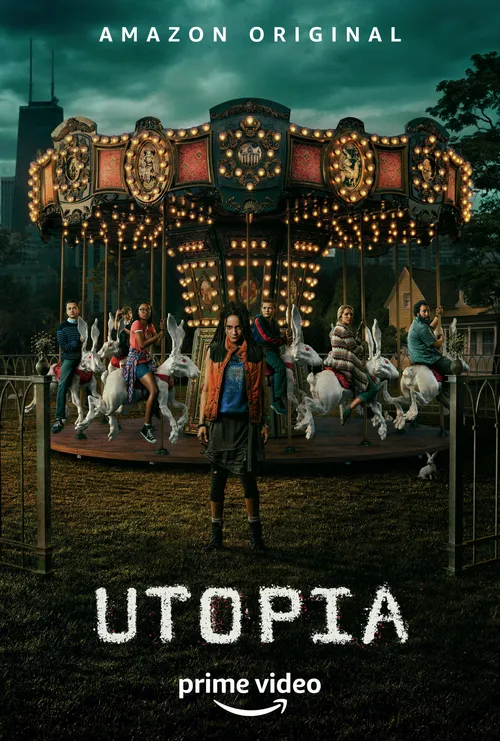



 TV SERIES · 2020
Utopia (2020)
Comic-book obsessives uncover a manuscript that maps a real biotech conspiracy and become targets of killers who will erase anyone who can read it. A hunted survivor and a pharma visionary pull the group into a brutal fight over what the pages really plan for the world.
Utopia (2020) follows utopia follows Ian, a withdrawn Utopia comic fan who connects with fellow devotees Becky, Samantha, Wilson Wilson, and teen Grant after pages of a long-rumored manuscript surface online and in the real world. The pages appear to forecast outbreaks, cover-ups, and a program tied to a powerful medical network, and the fans quickly learn that possessing them is a death sentence. Assassins close in while the group tries to decode the art and text before the next predicted event hits. Jessica Hyde, a scarred and highly trained young woman raised on the same mythos, forces her way into their orbit as both protector and threat. Parallel to their flight, Dr. Kevin Christie advances a public-health vision that the manuscript frames as something far darker than flu response. Trust fractures as each fan realizes the comic they loved was a briefing document, not fiction.
Jessica Hyde’s history with the people behind the manuscript collides with Christie’s inner circle, including family and operators who treat the fans as loose ends. Becky’s medical work, Samantha’s research instincts, Wilson’s paranoia, and Grant’s age all become leverage as the hunters tighten surveillance and stage violence meant to look random. The group splits, reunites, and bargains over whether to expose the plan, destroy the pages, or use them. Christie sells salvation through science while the manuscript’s endgame looks like engineered catastrophe and control. Alliances form under gunfire and interrogation; some characters break, others double down. By the season’s end the conspiracy is no longer a theory on paper—it is a live operation the survivors still only partly understand.
Oops! Is this show WOKE?
Only an account holder or member can file. Cite a scene, a line, or a pattern. Other account holders +1 or −1 that argument, once each. The show is not IS WOKE until enough of them have given a +1. Enough −1s remove the write-up, and it is no longer shown.
Sign in to file a woke label. One of each criterion per member.
Comments and reviews
Report a mistake
Same rule as woke labels: one report, a written reason, and the community +1 or −1 it — once per member. A net +5 applies the change. Editors can hold it for review, or apply it immediately.
No mistake reports yet.
Sign in to report a mistake. One report per field, per member.
Member review
Becky Soto
Oct 20, 2026
7/10I came to Utopia mostly because the premise hooked me right away—the idea of comic fans stumbling into something that turns out to be deadly real felt like the kind of story that could go either sharp or messy. I landed at 3.5 because it does a lot right without quite sticking the landing for me the whole way through. There is a lean energy to the early stretches that I genuinely liked. Watching Ian and the others piece together those pages, realizing the art and the text were pointing at outbreaks and cover-ups, had this nervous momentum that kept me leaning forward. It never felt like a standard conspiracy show where everyone already knows the rules. They feel outmatched from the start, and that stuck with me. One beat that still sits with me is the way the group first starts connecting the manuscript to actual events in the world. It is not a big speech or a reveal dump. It is quieter—people comparing notes, getting that sick feeling that the next predicted thing might already be moving. Becky and Samantha bounce off each other in a way that felt natural rather than written for tension, and Wilson Wilson’s weird intensity gave the room a different temperature. Grant being the kid in the mix added this extra layer of “we should not even have him here,” which the show mostly handles without turning him into a pure plot device. I appreciated that. Jessica Hyde forcing her way into their orbit is where the show gains a harder edge. She arrives already scarred and trained, and the way she moves through the story never feels like she is there to lecture anyone. She is a survivor who has been living inside the myth longer than the fans have been reading it, and that difference in experience creates friction that works. There is a stretch where the hunted feeling really lands—assassins closing in, the sense that simply being able to read the pages is enough to get you erased. I found myself more invested in the smaller survival choices than in the bigger biotech speeches. The pharma visionary side of things pulls the group into a brutal fight over what the manuscript actually plans, and some of those confrontations have real weight. You can feel the cost in the quieter aftermaths more than in the louder set pieces. Where it dips for me is in the middle-to-late stretches when the conspiracy mechanics start repeating their own rhythm. The manuscript keeps mapping new threats, the killers keep coming, and occasionally the show trusts the next twist a little more than it trusts the people carrying it. I never checked out, but I did notice myself waiting for the human texture to catch up again. Ian’s withdrawn quality is played straight, which I liked—he is not suddenly the action lead—but some of the group dynamics thin out when the plot needs them to move faster. The show is better when it lets the comic-book obsession feel like a real shared language instead of just the delivery system for the next clue. Those early decoding scenes, with everyone crowded around the art and arguing over what a panel might mean, had a weird warmth under the dread. I wanted more of that texture later on. Still, the core idea holds. A group of ordinary obsessives pulled into a fight over a biotech program that could reshape everything is a strong engine, and the show does not soft-pedal how ugly the fight gets. The assassins are not cartoon mustache-twirlers; they feel procedural and final, which makes the survivors’ improvisation matter more. Jessica Hyde’s presence keeps raising the stakes without turning her into an unearned superhero. She has clear limits and clear scars, and the moments where she has to decide how much of her own history to dump on these people land cleaner than a lot of “chosen one” storytelling does. I also liked that the manuscript itself stays a little slippery—art and text that forecast things without handing out neat answers—so the group is always half a step behind what the pages seem to want. By the time the larger fight over the world’s future settles into focus, I was still rooting for the messy little unit they had become, even when the plotting got heavier. It earns its tension more through paranoia and competence gaps than through constant spectacle, and that suits the material. I am not going to pretend every thread tied off cleanly for me, and a couple of the later pivots felt like they asked for more runway than the season gave them. But the parts that worked—those first connections between fans, the dread of being readable, Jessica Hyde cutting through the amateur hour with something harder—were strong enough that I did not regret the time. It is the kind of show that leaves a few specific images behind rather than a smooth overall grade, and for me that is worth the 3.5. I would rather have something with a distinct pulse that wobbles than something perfectly even and forgettable. Utopia has that pulse. It just does not keep it steady all the way through, and I can live with that trade.