
 TV
 VIDEO GAMES
 PODCASTS
 VIDCASTS
 STAND-UP



 MOVIE · 2026
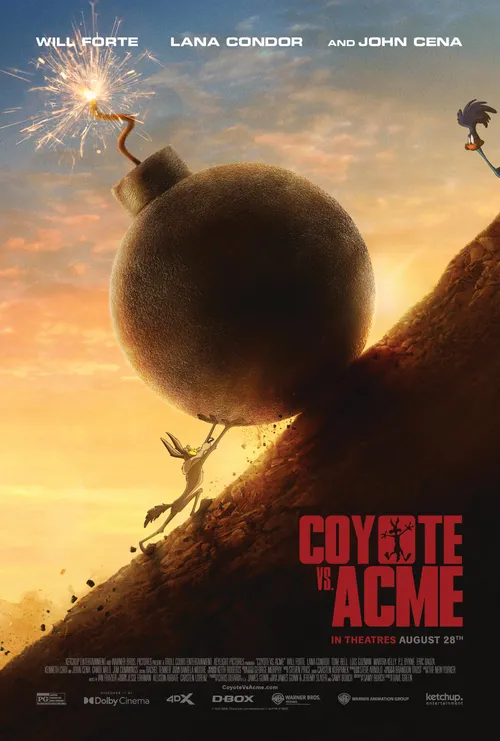
Coyote vs. Acme
Wile E. Coyote finally takes the ACME Corporation to court after a lifetime of exploding rockets, collapsing catapults, and other defective gadgets. He teams with a billboard personal-injury lawyer to demand accountability from the company that supplied every failed scheme.
Coyote vs. Acme follows Wile E. Coyote as the perennial desert pursuer reaches his limit with the manufacturer behind every malfunctioning rocket skate, giant spring, and anvil that has backfired on him. After one mishap too many, he seeks out a local attorney who advertises on roadside billboards and convinces the lawyer to file a product-liability suit against the sprawling ACME empire. The case draws in human supporting players who must navigate both the absurdity of cartoon physics and the dry procedures of civil court. Live-action sequences intercut with animated flashbacks of classic chases, establishing how each purchased device promised victory over the Road Runner yet delivered only injury and humiliation. Early hearings force Coyote to recount the catalogue of failures while ACME’s representatives treat the claims as routine customer complaints. The odd-couple partnership between the silent predator and his talkative counsel becomes the engine that keeps the lawsuit moving forward.
As discovery proceeds, Coyote and the attorney dig through warehouses of blueprints, warranty disclaimers, and test footage that reveal a pattern of reckless design. Corporate executives and eccentric inventors are deposed, each offering explanations that only deepen the comedy of industrial negligence. Alliances shift when unexpected witnesses—from rival cartoon figures to long-suffering ACME employees—surface with their own grievances or defenses. The lawyer must keep Coyote focused on legal strategy rather than fresh schemes, while Coyote’s single-minded determination continually tests the boundaries of courtroom decorum. Mounting evidence and public attention push the dispute toward a high-stakes trial that will decide whether the company that armed generations of slapstick disasters can finally be held responsible. The story stays rooted in the chase-and-catastrophe tradition even as it stages the ultimate consumer-revenge fantasy.
Click any of the following icons below to rent or stream it!
Oops! Is this show WOKE?
Only an account holder or member can file. Cite a scene, a line, or a pattern. Other account holders +1 or −1 that argument, once each. The show is not IS WOKE until enough of them have given a +1. Enough −1s remove the write-up, and it is no longer shown.
Sign in to file a woke label. One of each criterion per member.
Comments and reviews
Report a mistake
Same rule as woke labels: one report, a written reason, and the community +1 or −1 it — once per member. A net +5 applies the change. Editors can hold it for review, or apply it immediately.
No mistake reports yet.
Sign in to report a mistake. One report per field, per member.
Member review
Dan Reilly
Sep 26, 2026
8/10The biggest problem with Coyote vs. Acme is that it takes a while to settle on its own rhythm. The opening stretch leans hard on the expected slapstick pile-up—rockets misfiring, bridges collapsing, the usual desert carnage—and for the first twenty minutes or so I kept checking whether the courtroom stuff was ever going to feel like more than a framing device. Sitting in a packed Saturday showing, you could feel the audience waiting for the movie to stop reminding us it was a Looney Tunes property and start behaving like one. Some of the early gags play a little broad on a big screen; the timing that works in a short feels stretched when you know there’s a whole legal argument coming. Once the lawsuit actually gets moving, though, the film finds its footing. Wile E. stays pure cartoon—silent, elastic, permanently optimistic about the next catastrophic purchase—while the live-action side gives the lawyers and ACME brass enough room to breathe without turning into pure parody. The personal-injury attorney who takes the case isn’t written as a cartoon himself; he’s just a guy who sees a long paper trail of exploding anvils and decides the corporation that sold them should answer for it. That grounding helps. The product-liability angle is played mostly straight, which somehow makes the animated mishaps funnier when they get entered into evidence. Watching a giant spring or a pair of rocket skates get wheeled into a courtroom as Exhibit whatever had the whole theater laughing in that low, shared way you only get when everyone’s looking at the same screen. I went in half-expecting the movie to sand off the mean streak that made the old shorts work. It doesn’t. Coyote still gets flattened, burned, and dropped from ridiculous heights, and the film never apologizes for it. The difference is that those disasters now have a paper trail and a deposition. There’s a stretch in the middle where the lawyers walk through years of failed gadgets that actually made me sit up. You start noticing how consistent the pattern is—every single item works just long enough to raise hope and then fails in the exact way that guarantees maximum pain. Turning that into a legal case is smarter than it first sounds. It doesn’t feel like a cheap joke layered on top of nostalgia; it feels like someone finally asked what the endless chase would look like if anybody kept receipts. The hybrid animation and live action is cleaner than I expected. Coyote never looks pasted in. When he interacts with the human lawyers the weight and timing feel right, and the big-screen presentation helps—those elastic takes and sudden freeze-frames land harder when they’re twenty feet tall. A couple of the ACME executives are a little too cartoonish themselves, which undercuts the corporate satire a bit, but the core idea holds. The company that sold every last defective product to the desert is finally being forced to sit still and listen to the damage reports. That simple premise carries more of the movie than any single set piece. Not everything lands. There’s a subplot about the Road Runner’s own testimony that feels half-finished, and one or two of the later chase sequences drop back into pure clip-show mode when the script could have pushed the legal absurdity further. I also wish the film had trusted the silence of Coyote a little more in the quieter moments; occasionally it over-explains a reaction that the original shorts would have left alone. Still, those are quibbles against a movie that largely knows what it’s doing. By the time the closing arguments roll around, the audience I was with had fully bought in. People were reacting to the rulings the way they react to a good punchline—quick, collective, and then quiet again waiting for the next beat. What surprised me most is how little it needed to modernize the character. Coyote is still the same relentless, optimistic disaster he always was. The lawsuit simply gives his failures a new stage and a new set of opponents who can’t just vanish into the next commercial break. The live-action performances stay out of the way enough that the cartoon remains the star, which is exactly right. Walking out afterward I caught myself replaying a couple of the evidence montages and realizing I’d laughed harder at a filing cabinet full of scorched order forms than at some of the bigger explosions. That feels like the right kind of joke for this material. It’s not perfect, and the first act still drags its feet, but once the case is underway Coyote vs. Acme turns the endless cycle of hope and catastrophe into something that actually holds together for a full runtime. I gave it four stars because the stretch that works really works, and because it never forgets that the fun was always in watching the plan go wrong. On a big screen with a crowd that knew every classic gag by heart, those wrong turns still landed.