
 TV
 VIDEO GAMES
 PODCASTS
 VIDCASTS
 STAND-UP
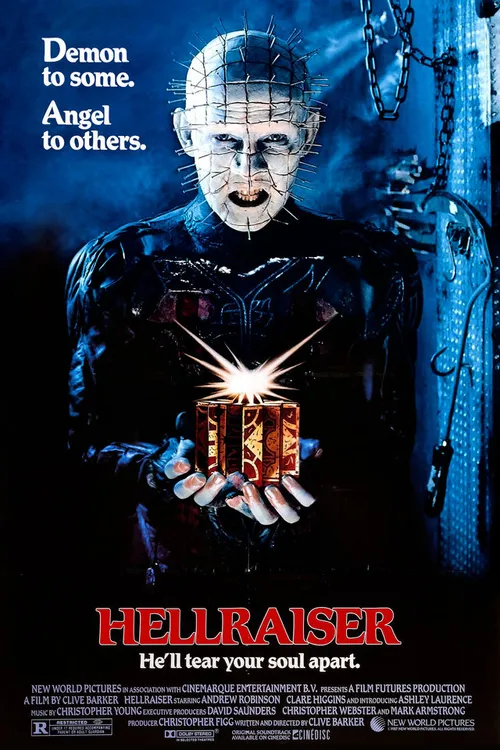



 MOVIE · 1987
Hellraiser
A hedonistic man solves a puzzle box that summons sadomasochistic Cenobites from another dimension where pain and pleasure are one. His brother-in-law's wife later discovers his partially formed resurrected body and kills to restore him while the entities hunt the escapee.
Hellraiser follows a hedonistic man who acquires a mysterious puzzle box said to open doors to ultimate pleasures. Solving it at home summons the Cenobites, extra-dimensional beings who tear him apart with hooked chains after he escapes their realm of indivisible pain and pleasure. Later his brother and the brother's wife move into the same house. Blood from an accidental cut resurrects the man in a ghoulish, incomplete form under the floorboards. The wife, who had been his lover, finds him and agrees to help rebuild his body so they can escape together. She lures men home and mortally wounds them so he can drain their blood and regenerate.
The brother's teenage daughter grows suspicious after seeing the wife bring a man to the house and follows her to the attic, discovering the skinless figure. She flees with the puzzle box and later opens it herself, summoning the Cenobites led by their nail-headed leader. They explain they are explorers who no longer distinguish pain from pleasure and agree to spare her if she leads them to the escaped man. Back at the house the regenerated figure has killed the brother and taken his skin. The Cenobites arrive after hearing a confession, tear the escapee apart with chains, and nearly take the daughter until she reverses the box and banishes them. She discards the box, which is later recovered by a mysterious figure and offered to a new customer.
Oops! Is this show WOKE?
Only an account holder or member can file. Cite a scene, a line, or a pattern. Other account holders +1 or −1 that argument, once each. The show is not IS WOKE until enough of them have given a +1. Enough −1s remove the write-up, and it is no longer shown.
Sign in to file a woke label. One of each criterion per member.
Comments and reviews
Report a mistake
Same rule as woke labels: one report, a written reason, and the community +1 or −1 it — once per member. A net +5 applies the change. Editors can hold it for review, or apply it immediately.
No mistake reports yet.
Sign in to report a mistake. One report per field, per member.
Member review
Peg Harlan
Oct 30, 2026
7/10Hellraiser from 1987 is one of those horror pictures I keep coming back to every few years, and every time I land in roughly the same place. I gave it 7 out of 10 again. It is not the tightest movie of its decade and it is nowhere near as clean as the best of the big franchises people still quote, but it has a stubborn pull that the cleaner ones sometimes lack. They used to make them like this when a director had one ugly idea and just ran with it until the walls got sticky. Frank solves the puzzle box because he wants more than ordinary sensation, and what shows up are the Cenobites. That premise still works. Pain and pleasure welded together is not a complicated idea, yet Barker treats it like a fact of physics instead of a lecture. Once the hooks come out and Frank is torn open, the movie stops pretending it is going to behave. I like that it does not soft-pedal the aftermath. Years later his brother’s household moves into the same place, a little blood hits the floorboards, and Frank starts knitting himself back together under the boards like something the house itself is trying to cough up. Julia, who already knew him too well, finds what is left and decides she will feed him. That choice is the real engine. She is not confused about what she is doing. She wants the version of him that made her feel something, and she will bring strangers home and finish them so he can take what he needs. Clare Higgins plays that without winking. You believe she has already crossed the line in her head long before the first kill. The set-up is clunky. It takes its time getting the pieces on the board, and some of the early talk feels like it is clearing its throat. I have never minded that much. The house itself does a lot of the work once the resurrection starts. Dark rooms, wet sounds, that half-formed body crawling toward whatever light it can find. The effects are a bit on the cheesy side by modern standards, yet they hold up in a strange way. Practical work like that has weight. You can tell someone spent hours sculpting and painting instead of painting over a problem in post. When the chains finally arrive for the second round, they still look like they could actually snag flesh. That matters more to me than polish. Acting is nothing special across the board, though I did like Clare Higgins and Ashley Laurence. Higgins carries the moral rot without turning it into a cartoon. Laurence’s Kirsty has the ordinary decency the rest of the house has already discarded, and she sells the panic without turning shrill. Doug Bradley as the Lead Cenobite is the one everyone remembers, and for good reason. He does not need a big speech. The voice and the stillness do most of it. You understand immediately that these creatures are not monsters in the Friday the 13th sense. They are specialists. They have rules. They came because someone rang their doorbell, and they intend to finish the transaction. That calm is scarier than ranting. I have always thought Hellraiser sits a little lower in the public ranking of 80s horror than Halloween, Friday the 13th, or Nightmare on Elm Street. Fair enough. Those films built cleaner mythologies and cleaner slashers. This one is messier and more interested in appetite than in a masked figure walking from kill to kill. The difference is why I still put it on. It feels like someone took the idea of forbidden experience seriously instead of turning it into a body-count contest. The Cenobites are not punishing sin in a Sunday-school way. They are delivering exactly what was requested, only the request was made by someone who did not understand the terms. That is a colder kind of horror. Julia’s arc is the part that stays with me. She is not redeemed and she is not turned into a pure villain for the audience to hiss at. She is a woman who tasted something intense, lost it, and will do ugly work to get it back. The movie lets her be competent at the ugliness. No speeches about empowerment, no need to shrink the men around her so she can look strong. She simply acts. Frank, even half-made, remains the same selfish hedonist who opened the box in the first place. Their reunion is not romantic. It is transactional and damp and wrong, which is exactly the point. The final stretch with the box and the returning Cenobites still has bite. You feel the rules snapping shut again. Kirsty has to bargain with something that does not bargain the way people do. The movie never quite explains the larger cosmology, and I prefer it that way. Too much lore would sand off the dread. Leave the Labyrinth half-seen. Leave Pinhead and the others as professionals who arrived because the puzzle was solved correctly. I am not going to pretend the dialogue is sharp or that every performance lands. Some of the supporting turns are stiff, and a couple of the early scenes drag their feet. None of that erases the central images or the nasty logic of the bargain. When I finish it I usually sit for a minute and think about how few films are willing to treat desire as something that can literally unmake a body. Most horror either winks or moralizes. This one just shows the bill coming due. So 7 out of 10. I will watch it again in a couple of years when I want something that still feels handmade and a little sick. The franchise wandered later, the way most of them do, but the first one keeps its shape. Puzzle box, hungry man, woman willing to kill for the feeling she lost, and things with hooks that keep their appointments. That is enough.